Quanta Magazine science
Latest Articles
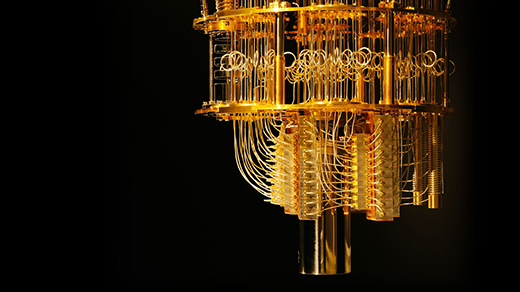
Researchers Reveal the Power of ‘Quantum Proofs’
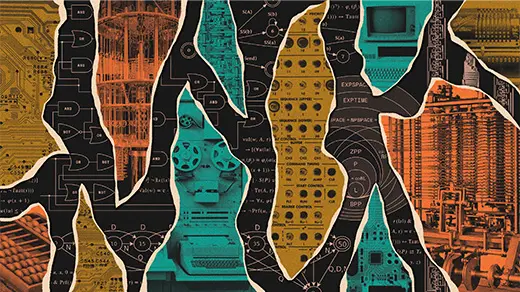
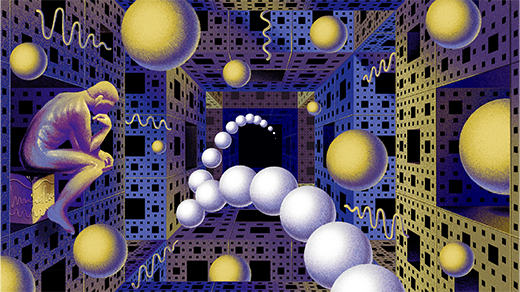
More than 30 years ago, researchers discovered that hypothetical computers based on the laws of quantum physics would be able to rapidly solve difficult math problems. Ever since then, they’ve sought to pinpoint cases where quantum computers are more powerful than their ordinary “classical” cousins. For nearly as long, a small band of computer scientists has pursued a related question that gets…
Source
0
3
Astrophysicists Puzzle Over Webb’s New Universe
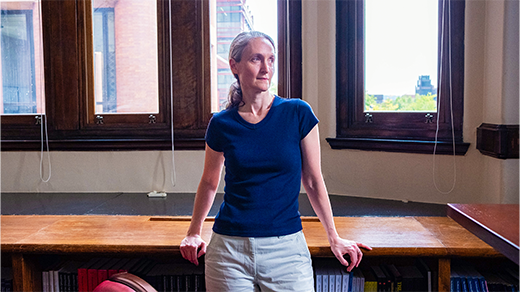
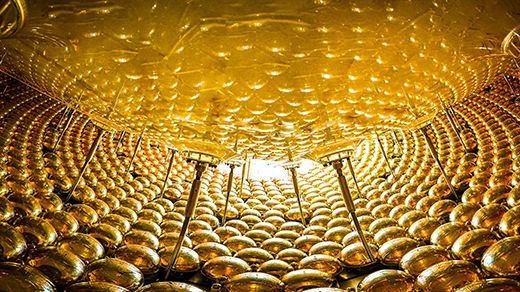
When Charlotte Mason ponders cosmic mysteries, she likes to doodle. “I am quite a visual person,” she said. “I usually draw a lot of pictures trying to understand what’s going on.” Mason, an astrophysicist at the Cosmic Dawn Center in Copenhagen, has lately been filling pages with sketches of “little red dots,” perplexing objects discovered by the hundreds in images from the James Webb Space…
Source
0
4
For the First Time, a Cell Built From Scratch Grows and Divides
For the very first time, biologists packed nonliving components into a cell-like membrane, piece by piece, and witnessed the bag of molecules start to behave like life. The lab-made synthetic cell grew, replicated its DNA, and divided, demonstrating the basic functions of a cell cycle. It’s “an impressive step,” said Jack Szostak, who studies the origins of life at the University of Chicago and…
Source
0
2
What Breaks a Cell’s Ribs Can Make It Stronger
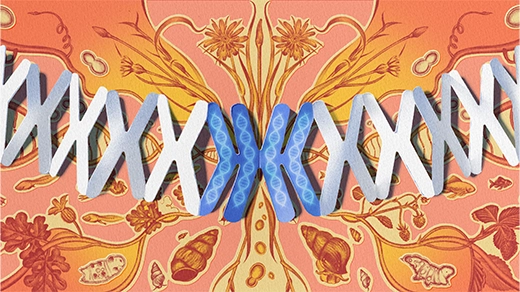
The cells of animals, plants, and fungi start their lives by being torn apart. Cells are born by division, and just before a parent cell becomes two daughters, it doubles its nuclear DNA and carefully condenses it into X-shaped chromosomes. The nucleus disassembles, letting these crucial genetic instructions float free in the cell’s soupy interior. Then the cell performs an astounding…
Source
0
1
After 80 Years, Mathematicians Give Famed ‘Erdős Method’ an Upgrade
In 1947, Paul Erdős, the itinerant Hungarian mathematician, introduced what would become one of math’s most powerful tools. He wanted to prove that a certain kind of object existed — in this case, a network made of interconnected nodes. But strangely, his proof didn’t specify how to build it. Instead, he showed that if you consider all networks and select one at random, the chances that you’ll…
Source
0
1
Why the Human Genome’s Tangled Physicality May Confound AI
Since its molecular structure was deduced in the 1950s, DNA has been hailed by many biologists as the secret of life. They’ve read and studied the information stored in the DNA found in the cells of living organisms, known as their genomes, and claimed that this genetic database must be some kind of blueprint, code script, or computer. But if DNA really does harbor some greater secret about how…
Source
0
8
Seven Perfect Shuffles Randomize a Deck of Cards. But How Many Sloppy Ones?
In 1992, mathematicians famously proved that seven “riffle shuffles” — the kind where a player splits a deck of cards into two piles, then uses their thumbs to interleave them back together in a zipperlike motion — are enough to mix up the deck. When Dave Bayer and Persi Diaconis came up with this proof, they also revealed something surprising about what happens along the way: At first…
Source
0
5
How Many Elementary Particles Are There, Really?
Every time I write about particle physics, I encounter a moment of uncertainty about a quantity that, at first glance, ought to be clear. How many kinds of elementary particles should I say there are? In experiments at the Large Hadron Collider, physicists smash together beams of protons, breaking them up into all possible elementary bits and pieces. Meanwhile, they have an incredibly accurate…
Source
0
3
Where Did Earth Get Its Oceans? Maybe It Made Them Itself.
At this moment, a spacecraft is headed from Earth to Europa, an ice-veiled moon of Jupiter thought to contain an ocean similar in some ways to one of our own. NASA engraved a metal plate affixed to the spacecraft with a poem, commissioned from Ada Limón during her time as poet laureate of the United States. It reads, in part: And it is not darkness that unites us, not the cold distance of…
Source
0
4
What’s the Future of Gene Editing?
One of the most surprising and remarkable discoveries in recent scientific history has been CRISPR. Short for Clustered Regularly Interspaced Short Palindromic Repeats, CRISPR is a form of immune system that evolved in bacteria more than a billion years ago to defend against persistent viral threats. Under attack, bacteria can snip a small fragment of a virus’s DNA, store it in the CRISPR region…
Source
0
4
An Early Step on the Long, Strange Road to Photosynthesis
Every second, trillions of watts of solar energy — more than 10,000 times the energy used by modern humans — blast the Earth’s surface. Around 2.4 billion years ago, life took an evolutionary leap when bacteria learned to harness these photons to break apart water molecules and stitch carbon atoms into sugars. Along the way, they flooded Earth’s atmosphere with oxygen and rewrote the rules of life.
Source
0
5
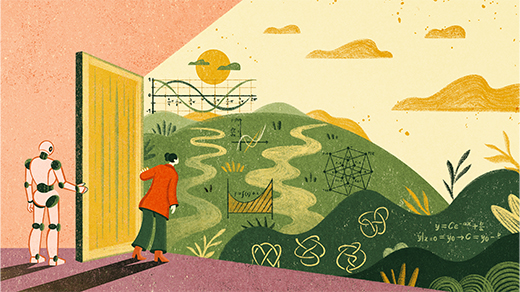
How Terry Tao Became an Evangelist for AI in Math
The following has been adapted from The Proof in the Code: How a Truth Machine Is Transforming Math and AI by Kevin Hartnett. Terry Tao has never been afraid of unconventional ideas. In November 2014, he was on a panel of five distinguished mathematicians, all inaugural recipients of the Breakthrough Prize in Mathematics, which came with a $3 million award. The laureates’ conversation ranged…
Source
0
3
Are Memories Transferable — or Edible?
I t was the dead of winter in Boston. The surface of the Charles River was frozen solid. But Zachary Kelso braved the biting cold to finally put to rest a mystery that has haunted neuroscience labs for over half a century. To do that, Kelso, a research assistant in the Harvard lab of the neuroscientist Sam Gershman, needed some worms. Specifically, planarians: arrow-headed flatworms…
Source
0
4
More Conversations, Complex Questions, and Bold Ideas in Season Five of ‘The Joy of Why’
What is the future of gene editing with CRISPR? Has AI changed mathematics forever? Will we find other civilizations in the universe? What if we’ve been wrong about dark energy all along? These are just a few of the big, bold questions we’ll be exploring in the new season of The Joy of Why. Mathematician Steven Strogatz and physicist Janna Levin are back as your hosts for these and other…
Source
0
4
Entanglement Builds Space-Time. Now “Magic” Gives It Gravity.
In 1973, John Archibald Wheeler described the relationship between space and matter in two sentences: “Space acts on matter, telling it how to move. In turn, matter reacts back on space, telling it how to curve.” Wheeler’s words serve as a pithy encapsulation of general relativity, Albert Einstein’s theory of gravity. Wheeler’s sentences also lay out a challenge that theorists face today: When…
Source
0
3
The Dirt That Refused To Die
For 15 years, Sébastien Fontaine has been trying to kill dirt. The biochemist, who runs a lab at the French National Institute for Agriculture, Food, and Environment, wanted to know how much carbon is released by soil — just dirt alone, completely devoid of life. His team sealed dirt into jars and blasted them with sterilizing gamma radiation. Then they waited for the carbon dioxide released by…
Source
0
3
Key Chemistry Question Answered, No Quantum Computer Required
What Garnet Chan cares most about is basic science. He entered chemistry decades ago to understand some of the most consequential biochemical processes on Earth. But since then, he’s become a central figure in a different arena: the debate over whether quantum computers will have a decisive advantage over ordinary “classical” ones. Over the past decade, many quantum computing researchers have…
Source
0
3
How We See the Beautiful, Violent Sun
The sun is one of the most studied objects in the history of science. The ancient Babylonians and Chinese tracked sunspots and solar eclipses, etching their observations into clay tablets; these records would outlast their civilizations. When the telescope arrived in the early 1600s, astronomers such as Galileo Galilei, Christoph Scheiner, and Johannes Fabricius turned these instruments toward…
Source
0
3
When Quiet Undersea Volcanoes Turn Disruptive
Jonas Preine, a recently minted Ph.D. from the University of Hamburg, squinted at a computer screen in the lab of a ship as it bobbed in the North Atlantic near Iceland. The image before him just didn’t make sense. It was June 2024, and Preine was among a crew of scientists who had set off from Reykjavik under slate-colored skies, trading their regular lives — family, friends…
Source
0
7
How Ecotypes Harbor the Genetic Memory of a Species’ Past
When she was a graduate student in the 1970s, the evolutionary biologist Kerstin Johannesson regularly walked the shores of a Swedish archipelago, scanning the ground for pebbles that moved: marine snails. Her adviser, a taxonomist, had tasked her with describing the species present there by documenting their traits. She noticed that snails with thicker shells stayed on the shore…
Source
0
4
Researchers Reveal the Power of ‘Quantum Proofs’
More than 30 years ago, researchers discovered that hypothetical computers based on the laws of quantum physics would be
0
3
Astrophysicists Puzzle Over Webb’s New Universe
When Charlotte Mason ponders cosmic mysteries, she likes to doodle. “I am quite a visual person,” she said.
0
4
For the First Time, a Cell Built From Scratch Grows and Divides
For the very first time, biologists packed nonliving components into a cell-like membrane, piece by piece, and witn
0
2
What Breaks a Cell’s Ribs Can Make It Stronger
The cells of animals, plants, and fungi start their lives by being torn apart. Cells are born by division, and just befo
0
1
After 80 Years, Mathematicians Give Famed ‘Erdős Method’ an Upgrade
In 1947, Paul Erdős, the itinerant Hungarian mathematician, introduced what would become one of math’s most powerf
0
1
Why the Human Genome’s Tangled Physicality May Confound AI
Since its molecular structure was deduced in the 1950s, DNA has been hailed by many biologists as the secret of life. Th
0
8
Seven Perfect Shuffles Randomize a Deck of Cards. But How Many Sloppy Ones?
In 1992, mathematicians famously proved that seven “riffle shuffles” — the kind where a player splits
0
5
How Many Elementary Particles Are There, Really?
Every time I write about particle physics, I encounter a moment of uncertainty about a quantity that, at first glance, o
0
3
Where Did Earth Get Its Oceans? Maybe It Made Them Itself.
At this moment, a spacecraft is headed from Earth to Europa, an ice-veiled moon of Jupiter thought to contain an oc
0
4
What’s the Future of Gene Editing?
One of the most surprising and remarkable discoveries in recent scientific history has been CRISPR. Short for Clustered
0
4
An Early Step on the Long, Strange Road to Photosynthesis
Every second, trillions of watts of solar energy — more than 10,000 times the energy used by modern humans —
0
5
How Terry Tao Became an Evangelist for AI in Math
The following has been adapted from The Proof in the Code: How a Truth Machine Is Transforming Math and AI by Kevin Hart
0
3
Are Memories Transferable — or Edible?
I t was the dead of winter in Boston. The surface of the Charles River was frozen solid. But Zachary Kelso braved the bi
0
4
More Conversations, Complex Questions, and Bold Ideas in Season Five of ‘The Joy of Why’
What is the future of gene editing with CRISPR? Has AI changed mathematics forever? Will we find other civilizations in
0
4
Entanglement Builds Space-Time. Now “Magic” Gives It Gravity.
In 1973, John Archibald Wheeler described the relationship between space and matter in two sentences: “Space acts
0
3
The Dirt That Refused To Die
For 15 years, Sébastien Fontaine has been trying to kill dirt. The biochemist, who runs a lab at the French Natio
0
3
Key Chemistry Question Answered, No Quantum Computer Required
What Garnet Chan cares most about is basic science. He entered chemistry decades ago to understand some of the most cons
0
3
How We See the Beautiful, Violent Sun
The sun is one of the most studied objects in the history of science. The ancient Babylonians and Chinese tracked sunspo
0
3
Researchers Reveal the Power of ‘Quantum Proofs’
More than 30 years ago, researchers discovered that hypothetical computers based on the laws of quantum physics would be able to rapidly solve difficult math problems. Ever since then, they’ve sought to pinpoint cases where quantum computers are more powerful than their ordinary “classical” cousins. For nearly as long, a small band of computer scientists has pursued a related question that gets…
Source
0
3 👁
Astrophysicists Puzzle Over Webb’s New Universe
When Charlotte Mason ponders cosmic mysteries, she likes to doodle. “I am quite a visual person,” she said. “I usually draw a lot of pictures trying to understand what’s going on.” Mason, an astrophysicist at the Cosmic Dawn Center in Copenhagen, has lately been filling pages with sketches of “little red dots,” perplexing objects discovered by the hundreds in images from the James Webb Space…
Source
0
4 👁
For the First Time, a Cell Built From Scratch Grows and Divides
For the very first time, biologists packed nonliving components into a cell-like membrane, piece by piece, and witnessed the bag of molecules start to behave like life. The lab-made synthetic cell grew, replicated its DNA, and divided, demonstrating the basic functions of a cell cycle. It’s “an impressive step,” said Jack Szostak, who studies the origins of life at the University of Chicago and…
Source
0
2 👁
What Breaks a Cell’s Ribs Can Make It Stronger
The cells of animals, plants, and fungi start their lives by being torn apart. Cells are born by division, and just before a parent cell becomes two daughters, it doubles its nuclear DNA and carefully condenses it into X-shaped chromosomes. The nucleus disassembles, letting these crucial genetic instructions float free in the cell’s soupy interior. Then the cell performs an astounding…
Source
0
1 👁
After 80 Years, Mathematicians Give Famed ‘Erdős Method’ an Upgrade
In 1947, Paul Erdős, the itinerant Hungarian mathematician, introduced what would become one of math’s most powerful tools. He wanted to prove that a certain kind of object existed — in this case, a network made of interconnected nodes. But strangely, his proof didn’t specify how to build it. Instead, he showed that if you consider all networks and select one at random, the chances that you’ll…
Source
0
1 👁
Why the Human Genome’s Tangled Physicality May Confound AI
Since its molecular structure was deduced in the 1950s, DNA has been hailed by many biologists as the secret of life. They’ve read and studied the information stored in the DNA found in the cells of living organisms, known as their genomes, and claimed that this genetic database must be some kind of blueprint, code script, or computer. But if DNA really does harbor some greater secret about how…
Source
0
8 👁
Seven Perfect Shuffles Randomize a Deck of Cards. But How Many Sloppy Ones?
In 1992, mathematicians famously proved that seven “riffle shuffles” — the kind where a player splits a deck of cards into two piles, then uses their thumbs to interleave them back together in a zipperlike motion — are enough to mix up the deck. When Dave Bayer and Persi Diaconis came up with this proof, they also revealed something surprising about what happens along the way: At first…
Source
0
5 👁
How Many Elementary Particles Are There, Really?
Every time I write about particle physics, I encounter a moment of uncertainty about a quantity that, at first glance, ought to be clear. How many kinds of elementary particles should I say there are? In experiments at the Large Hadron Collider, physicists smash together beams of protons, breaking them up into all possible elementary bits and pieces. Meanwhile, they have an incredibly accurate…
Source
0
3 👁
Where Did Earth Get Its Oceans? Maybe It Made Them Itself.
At this moment, a spacecraft is headed from Earth to Europa, an ice-veiled moon of Jupiter thought to contain an ocean similar in some ways to one of our own. NASA engraved a metal plate affixed to the spacecraft with a poem, commissioned from Ada Limón during her time as poet laureate of the United States. It reads, in part: And it is not darkness that unites us, not the cold distance of…
Source
0
4 👁
What’s the Future of Gene Editing?
One of the most surprising and remarkable discoveries in recent scientific history has been CRISPR. Short for Clustered Regularly Interspaced Short Palindromic Repeats, CRISPR is a form of immune system that evolved in bacteria more than a billion years ago to defend against persistent viral threats. Under attack, bacteria can snip a small fragment of a virus’s DNA, store it in the CRISPR region…
Source
0
4 👁
An Early Step on the Long, Strange Road to Photosynthesis
Every second, trillions of watts of solar energy — more than 10,000 times the energy used by modern humans — blast the Earth’s surface. Around 2.4 billion years ago, life took an evolutionary leap when bacteria learned to harness these photons to break apart water molecules and stitch carbon atoms into sugars. Along the way, they flooded Earth’s atmosphere with oxygen and rewrote the rules of life.
Source
0
5 👁
How Terry Tao Became an Evangelist for AI in Math
The following has been adapted from The Proof in the Code: How a Truth Machine Is Transforming Math and AI by Kevin Hartnett. Terry Tao has never been afraid of unconventional ideas. In November 2014, he was on a panel of five distinguished mathematicians, all inaugural recipients of the Breakthrough Prize in Mathematics, which came with a $3 million award. The laureates’ conversation ranged…
Source
0
3 👁
Are Memories Transferable — or Edible?
I t was the dead of winter in Boston. The surface of the Charles River was frozen solid. But Zachary Kelso braved the biting cold to finally put to rest a mystery that has haunted neuroscience labs for over half a century. To do that, Kelso, a research assistant in the Harvard lab of the neuroscientist Sam Gershman, needed some worms. Specifically, planarians: arrow-headed flatworms…
Source
0
4 👁
More Conversations, Complex Questions, and Bold Ideas in Season Five of ‘The Joy of Why’
What is the future of gene editing with CRISPR? Has AI changed mathematics forever? Will we find other civilizations in the universe? What if we’ve been wrong about dark energy all along? These are just a few of the big, bold questions we’ll be exploring in the new season of The Joy of Why. Mathematician Steven Strogatz and physicist Janna Levin are back as your hosts for these and other…
Source
0
4 👁
Entanglement Builds Space-Time. Now “Magic” Gives It Gravity.
In 1973, John Archibald Wheeler described the relationship between space and matter in two sentences: “Space acts on matter, telling it how to move. In turn, matter reacts back on space, telling it how to curve.” Wheeler’s words serve as a pithy encapsulation of general relativity, Albert Einstein’s theory of gravity. Wheeler’s sentences also lay out a challenge that theorists face today: When…
Source
0
3 👁
The Dirt That Refused To Die
For 15 years, Sébastien Fontaine has been trying to kill dirt. The biochemist, who runs a lab at the French National Institute for Agriculture, Food, and Environment, wanted to know how much carbon is released by soil — just dirt alone, completely devoid of life. His team sealed dirt into jars and blasted them with sterilizing gamma radiation. Then they waited for the carbon dioxide released by…
Source
0
3 👁
Key Chemistry Question Answered, No Quantum Computer Required
What Garnet Chan cares most about is basic science. He entered chemistry decades ago to understand some of the most consequential biochemical processes on Earth. But since then, he’s become a central figure in a different arena: the debate over whether quantum computers will have a decisive advantage over ordinary “classical” ones. Over the past decade, many quantum computing researchers have…
Source
0
3 👁
How We See the Beautiful, Violent Sun
The sun is one of the most studied objects in the history of science. The ancient Babylonians and Chinese tracked sunspots and solar eclipses, etching their observations into clay tablets; these records would outlast their civilizations. When the telescope arrived in the early 1600s, astronomers such as Galileo Galilei, Christoph Scheiner, and Johannes Fabricius turned these instruments toward…
Source
0
3 👁
When Quiet Undersea Volcanoes Turn Disruptive
Jonas Preine, a recently minted Ph.D. from the University of Hamburg, squinted at a computer screen in the lab of a ship as it bobbed in the North Atlantic near Iceland. The image before him just didn’t make sense. It was June 2024, and Preine was among a crew of scientists who had set off from Reykjavik under slate-colored skies, trading their regular lives — family, friends…
Source
0
7 👁
How Ecotypes Harbor the Genetic Memory of a Species’ Past
When she was a graduate student in the 1970s, the evolutionary biologist Kerstin Johannesson regularly walked the shores of a Swedish archipelago, scanning the ground for pebbles that moved: marine snails. Her adviser, a taxonomist, had tasked her with describing the species present there by documenting their traits. She noticed that snails with thicker shells stayed on the shore…
Source
0
4 👁
Researchers Reveal the Power of ‘Quantum Proofs’
More than 30 years ago, researchers discovered that hypothetical computers based on the laws of quantum physics would be able to r…
💬 0
👁 3
Astrophysicists Puzzle Over Webb’s New Universe
Quanta Magazine · Jul 2, 2026
💬 0
👁 4
For the First Time, a Cell Built From Scratch Grows and Divides
Quanta Magazine · Jul 1, 2026
💬 0
👁 2
What Breaks a Cell’s Ribs Can Make It Stronger
Quanta Magazine · Jun 29, 2026
💬 0
👁 1

After 80 Years, Mathematicians Give Famed ‘Erdős Method’ an Upgrade
Quanta Magazine · Jun 26, 2026

Why the Human Genome’s Tangled Physicality May Confound AI
Quanta Magazine · Jun 18, 2026

Seven Perfect Shuffles Randomize a Deck of Cards. But How Many Sloppy Ones?
Quanta Magazine · Jun 17, 2026

How Many Elementary Particles Are There, Really?
Quanta Magazine · Jun 15, 2026
Where Did Earth Get Its Oceans? Maybe It Made Them Itself.
At this moment, a spacecraft is headed from Earth to Europa, an ice-veiled moon of Jupiter thought to contain an ocean simila…
💬 0
👁 4
What’s the Future of Gene Editing?
Quanta Magazine · Jun 11, 2026
💬 0
👁 4
An Early Step on the Long, Strange Road to Photosynthesis
Quanta Magazine · Jun 10, 2026
💬 0
👁 5
How Terry Tao Became an Evangelist for AI in Math
Quanta Magazine · Jun 8, 2026
💬 0
👁 3

Are Memories Transferable — or Edible?
Quanta Magazine · Jun 5, 2026

More Conversations, Complex Questions, and Bold Ideas in Season Five of ‘The Joy of Why’
Quanta Magazine · Jun 4, 2026

Entanglement Builds Space-Time. Now “Magic” Gives It Gravity.
Quanta Magazine · Jun 3, 2026

The Dirt That Refused To Die
Quanta Magazine · Jun 1, 2026
Key Chemistry Question Answered, No Quantum Computer Required
What Garnet Chan cares most about is basic science. He entered chemistry decades ago to understand some of the most consequential …
💬 0
👁 3