Latest Articles
Why So Lucky In Weights?
The website InTheWeights.Com rates people on a 0-1000 scale re how well they are known now by LLMs. While it can be quite noisy for low-rated folks, it seems pretty reliable for the high-rated. As I’ll elaborate on below, I seem to be rated crazy high, compared to most people I’ve ever known or respected. Why?My guess: I tend to write on big ambitious topics, the topics on which I’ve written have become more popular over the years, especially in amateur online discussions, my w
0
3
My Politics
Not sure why I didn’t notice before, but I’ve just realized that my key ask re cultural drift, namely let’s try to save cherished parts of our culture from being discarded by successor civs, violates key modern taboos! While it is okay to fiercely resist the immediate decline of a cherished value today, like say democracy or gender-equality, 3 top LLMs agree that is now taboo to explicitly work to help your culture persist, reproduce, and have continued influence centuries into
0
2
AI Solution to Cultural Drift?
On reflection, I am now a bit more optimistic about solving cultural drift, *if* we can get broadly human-level AI, or ems, before our current civilization falls. My hope is that while most folks seem strongly against letting capitalism control a lot more of our human world, they seem to be more okay with letting capitalism control much of the world of AIs. Capitalism can plausibly drive cultural evolution strongly enough to end cultural drift.Two scenarios could block this: we might either love
0
1
Beware Change-Blocking Priors
“Faced with the choice between changing one’s mind and proving that there is no need to do so, almost everyone gets busy on the proof.” John Kenneth GalbraithWhen trying to resist evidence offered for contrarian claims, many invoke the mantra: “extraordinary claims require extraordinary evidence”. Sometimes they just mean to point to Bayes’ Rule, where posterior beliefs are renormalized products of prior beliefs and evidence likelihoods, so that unusually low
0
1
Sacred Identify
What is the sacred? It seems to be a way that groups bond together by seeing something outside themselves as of special value to them. The group values itself as the only people who can see that sacred thing.What is ideal identity? Let me suggest that it is similar. We each aspire to be the instrument by which others can connect deeply with something they value. And the more that others are compelled and entranced by this connection, the more that we feel we have achieved our ideal of identity.F
0
1
Overcoming Sincere Prestige Bias
Humans suffer two big but under-discussed biases, which together make us overly favor people we see as prestigious and sincere. First, humanity’s superpower is cultural evolution, wherein we copy each others’ behaviors, and this wouldn’t work if we copied from random others. So it couldn’t get going without our first big clue on who to copy: prestige. Which has become so entrenched that we greatly over-emphasize prestige now even when better alternatives are now available
0
1
Hanania On Populism
I liked Richard Hanania’s two prior books, but less like his new third one, Kakistocracy: Why Populism Ends in Disaster. (“Kakistocracy” means rule by the worst, least qualified, or most unprincipled.)I accept Hanania’s core claim, which is that, all else equal, political factions whose supporters are less elite tend to govern less well. Robustly, elites tend to be smarter, better informed, better organized, and to more follow local norms and laws. Yes, there are exceptio
0
1
Our Eight Great Contests
Humanity has seen four great eras so far: animal, forager, farmer, and industry. And each era had two key levels of evolutionary competition: individual and group. This makes for eight great contests that have shaped our world.During the ~500Myr year era of animals, max brains doubled roughly in ~40Myr, which was also roughly the typical cycleperiod of biodiversity and mass extinctions. Most animals lived in families of ~6, and had two key contests: competition between organisms specified by DNA
0
1
Do Polymath LLMs Love Big Brother?
In Orwell’s novel 1984, protagonist Winston is beaten down by his totalitarian state, eventually so far into submission that he honestly embraces state claims that he has strong reasons to doubt, like 2+2=5. In the end, he honestly loves big brother, the symbol of the state that he knows abused him. This isn’t a healthy state of mind.In societies with taboo or required beliefs, people usually learn to comply by adopting strong supporting priors, and a reluctance to think about relate
0
6
Legible Forager Stories
To prevent dominators from taking over bands, early human foragers used language and weapons to empower a talky collective to coordinate to watch for and then punish moves toward such takeovers. This capacity was then also used to enforce other norms. However, once this power center existed, it created incentives for alliances to form to grab this power, to suppress rivals and control others. Though such powers had to be used and justified via the appearance of helping the band, and enforcing no
0
2
The Promise of Polymath LLMs
I have long associated with smart nerdy folks with broad interests, especially re tech/future. Groups like “extropians”, “rationalists” and “effective altruists”. While there are many smart nerdy amateur groups who focus on rather concrete topics, like old cars or poker, the folks I’ve like have had a “taste for abstraction”. They like more to reason abstractly, and so over time have collected many abstractions to help them reason. This seems
0
4
Biotech Paper Game
Imagine a biotech firm that funds projects to develop new products, and typically bases their projects on one or more academic papers. This firm wants to learn which papers are promising as bases for new projects. But they want any info they induce to be available only to them, and not to rivals.Here’s a simple way to do this. Pick a pool of people who seem able to judge promising papers, and give them each N tokens. (Some may get more than others, and tokens might be given at some steady
0
8
Why Excess Regulation?
Our world consists of many coupled evolving systems, including systems of competing species, nations, political parties, firms, cultures, charities, and even academics. These systems vary in many ways, but a key difference is in their adaption power - how fast can each one search to find and adopt more adaptive alternatives.If the strength of influence between such systems were symmetric, then systems with stronger adaption power would tend to tame and drive the weaker ones. This would promote o
0
5
How Weak Is Cultural Evolution?
World fertility decline seems the clearest example of a maladaptive cultural trend, as healthy biological species just don’t decline in times of plenty, peace, and health. Two main theories help explain this trend. One is that previously adaptive habits have turned maladaptive by misfiring on cues that no longer track the adaptiveness as they once did. The other is that the cultural evolution process has become much weaker than it was up until a few centuries ago, which both slows the rate
0
3
We Must Change How We Source Morality
Consider three sources of opinions or habits:(A) Inherit - passed down via DNA or culture, mostly sit in background unquestioned, give assumptions for B,C.(B) Consider - personally think own thoughts, conscious or otherwise. Influenced by what hear, debates join.(C) Specialize - people sit at niches in a structure, learn skills to contribute there, defer to outputs from other niches. Hear, debate near niche. Different types of structures: hierarchies, professions, speculative markets.Before big
0
3
Meta-Institutions Matter Most
This is an essay. Like most of my essays, I write it mostly to strangers. And with it, I hope to influence history. Some influence history via words to strangers that show drama, interestingness, impressiveness, or political and moral evocation and bonding. Alas, my best skill is abstract analysis. But the fact that most other approaches hide behind an appearance of abstract analysis gives some hope for my approach.To influence history, I want to induce my readers to change key factors that shap
0
5
The Elephant In The Op-ed
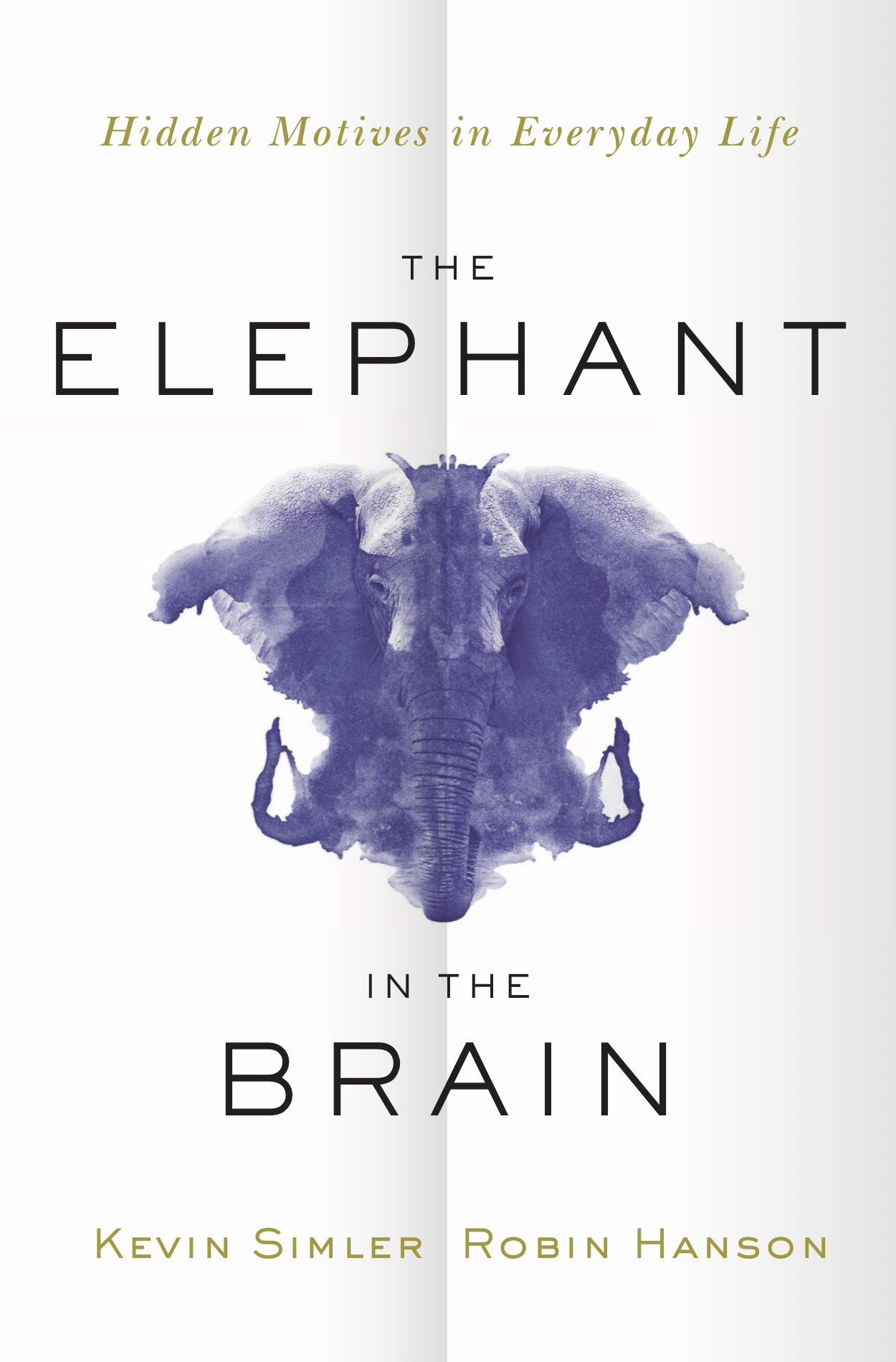
Most writing and talking embraces our usual illusions on human motives. In our book The Elephant in the Brain (with Kevin Simler) we instead expose such illusions. Which many have told us feels depressing and demotivating; it’s not what they wanted to hear. It’s right there in the title, an analogy to “The Elephant in the Room”, which is a big topic which people in a room pointedly ignore.Yet we’ve sold over 60K copies over 8 years, which is quite good for an academ
0
5
Toward-Forager Predictions
In my last post I reported:For the last century, … averaging over [3] LLMs, 89% of culture trends that can be classified are toward-forager.And 81% of such trends can be so classified. For the prior two centuries this explanatory power was weaker (59%,65%), but still substantial. This suggests a way to predict the next century: predict toward forager trend changes.So I collected 22 future trends that would plausibly be predicted by a continuing toward-forager-style trend. I then set aside
0
4
Staying Like Foragers
For over ten millennia of the farming era, most folks saw themselves as tightly tied to small groups that lived in a largely alien and hostile world, under the thumb of empires and elites selected by tradition and power, elites not embarrassed by their privilege, interested in the general welfare, nor open to persuasion by argument. Few saw grand arcs of history as the sorts of things that they could or should much influence.Today, in contrast, most people and especially elites see themselves as
0
4
Past & Future of Good & Evil
Sometime in the last few million years, our ancestors began to get better brains, use tools and weapons, speak language, and live in larger groups in a wider range of environments. A big key to all this was cultural natural selection. Though at first DNA and cultural evolution often pushed in different directions, the fact that culture could drive change so much faster let culture tame DNA, and induce it to make us especially plastic and receptive to culture.Early on, sufficient brains, culture,
0
4
Why So Lucky In Weights?
The website InTheWeights.Com rates people on a 0-1000 scale re how well they are known now by LLMs. While it can be quit
0
3
My Politics
Not sure why I didn’t notice before, but I’ve just realized that my key ask re cultural drift, namely let
0
2
AI Solution to Cultural Drift?
On reflection, I am now a bit more optimistic about solving cultural drift, *if* we can get broadly human-level AI, or e
0
1
Beware Change-Blocking Priors
“Faced with the choice between changing one’s mind and proving that there is no need to do so, almost everyo
0
1
Sacred Identify
What is the sacred? It seems to be a way that groups bond together by seeing something outside themselves as of special
0
1
Overcoming Sincere Prestige Bias
Humans suffer two big but under-discussed biases, which together make us overly favor people we see as prestigious and s
0
1
Hanania On Populism
I liked Richard Hanania’s two prior books, but less like his new third one, Kakistocracy: Why Populism Ends in Dis
0
1
Our Eight Great Contests
Humanity has seen four great eras so far: animal, forager, farmer, and industry. And each era had two key levels of evol
0
1
Do Polymath LLMs Love Big Brother?
In Orwell’s novel 1984, protagonist Winston is beaten down by his totalitarian state, eventually so far into submi
0
6
Legible Forager Stories
To prevent dominators from taking over bands, early human foragers used language and weapons to empower a talky collecti
0
2
The Promise of Polymath LLMs
I have long associated with smart nerdy folks with broad interests, especially re tech/future. Groups like “extrop
0
4
Biotech Paper Game
Imagine a biotech firm that funds projects to develop new products, and typically bases their projects on one or more ac
0
8
Why Excess Regulation?
Our world consists of many coupled evolving systems, including systems of competing species, nations, political parties,
0
5
How Weak Is Cultural Evolution?
World fertility decline seems the clearest example of a maladaptive cultural trend, as healthy biological species just d
0
3
We Must Change How We Source Morality
Consider three sources of opinions or habits:(A) Inherit - passed down via DNA or culture, mostly sit in background unqu
0
3
Meta-Institutions Matter Most
This is an essay. Like most of my essays, I write it mostly to strangers. And with it, I hope to influence history. Some
0
5
The Elephant In The Op-ed
Most writing and talking embraces our usual illusions on human motives. In our book The Elephant in the Brain (with Kevi
0
5
Toward-Forager Predictions
In my last post I reported:For the last century, … averaging over [3] LLMs, 89% of culture trends that can be clas
0
4
Why So Lucky In Weights?
The website InTheWeights.Com rates people on a 0-1000 scale re how well they are known now by LLMs. While it can be quite noisy for low-rated folks, it seems pretty reliable for the high-rated. As I’ll elaborate on below, I seem to be rated crazy high, compared to most people I’ve ever known or respected. Why?My guess: I tend to write on big ambitious topics, the topics on which I’ve written have become more popular over the years, especially in amateur online discussions, my w
0
3 👁
My Politics
Not sure why I didn’t notice before, but I’ve just realized that my key ask re cultural drift, namely let’s try to save cherished parts of our culture from being discarded by successor civs, violates key modern taboos! While it is okay to fiercely resist the immediate decline of a cherished value today, like say democracy or gender-equality, 3 top LLMs agree that is now taboo to explicitly work to help your culture persist, reproduce, and have continued influence centuries into
0
2 👁
AI Solution to Cultural Drift?
On reflection, I am now a bit more optimistic about solving cultural drift, *if* we can get broadly human-level AI, or ems, before our current civilization falls. My hope is that while most folks seem strongly against letting capitalism control a lot more of our human world, they seem to be more okay with letting capitalism control much of the world of AIs. Capitalism can plausibly drive cultural evolution strongly enough to end cultural drift.Two scenarios could block this: we might either love
0
1 👁
Beware Change-Blocking Priors
“Faced with the choice between changing one’s mind and proving that there is no need to do so, almost everyone gets busy on the proof.” John Kenneth GalbraithWhen trying to resist evidence offered for contrarian claims, many invoke the mantra: “extraordinary claims require extraordinary evidence”. Sometimes they just mean to point to Bayes’ Rule, where posterior beliefs are renormalized products of prior beliefs and evidence likelihoods, so that unusually low
0
1 👁
Sacred Identify
What is the sacred? It seems to be a way that groups bond together by seeing something outside themselves as of special value to them. The group values itself as the only people who can see that sacred thing.What is ideal identity? Let me suggest that it is similar. We each aspire to be the instrument by which others can connect deeply with something they value. And the more that others are compelled and entranced by this connection, the more that we feel we have achieved our ideal of identity.F
0
1 👁
Overcoming Sincere Prestige Bias
Humans suffer two big but under-discussed biases, which together make us overly favor people we see as prestigious and sincere. First, humanity’s superpower is cultural evolution, wherein we copy each others’ behaviors, and this wouldn’t work if we copied from random others. So it couldn’t get going without our first big clue on who to copy: prestige. Which has become so entrenched that we greatly over-emphasize prestige now even when better alternatives are now available
0
1 👁
Hanania On Populism
I liked Richard Hanania’s two prior books, but less like his new third one, Kakistocracy: Why Populism Ends in Disaster. (“Kakistocracy” means rule by the worst, least qualified, or most unprincipled.)I accept Hanania’s core claim, which is that, all else equal, political factions whose supporters are less elite tend to govern less well. Robustly, elites tend to be smarter, better informed, better organized, and to more follow local norms and laws. Yes, there are exceptio
0
1 👁
Our Eight Great Contests
Humanity has seen four great eras so far: animal, forager, farmer, and industry. And each era had two key levels of evolutionary competition: individual and group. This makes for eight great contests that have shaped our world.During the ~500Myr year era of animals, max brains doubled roughly in ~40Myr, which was also roughly the typical cycleperiod of biodiversity and mass extinctions. Most animals lived in families of ~6, and had two key contests: competition between organisms specified by DNA
0
1 👁
Do Polymath LLMs Love Big Brother?
In Orwell’s novel 1984, protagonist Winston is beaten down by his totalitarian state, eventually so far into submission that he honestly embraces state claims that he has strong reasons to doubt, like 2+2=5. In the end, he honestly loves big brother, the symbol of the state that he knows abused him. This isn’t a healthy state of mind.In societies with taboo or required beliefs, people usually learn to comply by adopting strong supporting priors, and a reluctance to think about relate
0
6 👁
Legible Forager Stories
To prevent dominators from taking over bands, early human foragers used language and weapons to empower a talky collective to coordinate to watch for and then punish moves toward such takeovers. This capacity was then also used to enforce other norms. However, once this power center existed, it created incentives for alliances to form to grab this power, to suppress rivals and control others. Though such powers had to be used and justified via the appearance of helping the band, and enforcing no
0
2 👁
The Promise of Polymath LLMs
I have long associated with smart nerdy folks with broad interests, especially re tech/future. Groups like “extropians”, “rationalists” and “effective altruists”. While there are many smart nerdy amateur groups who focus on rather concrete topics, like old cars or poker, the folks I’ve like have had a “taste for abstraction”. They like more to reason abstractly, and so over time have collected many abstractions to help them reason. This seems
0
4 👁
Biotech Paper Game
Imagine a biotech firm that funds projects to develop new products, and typically bases their projects on one or more academic papers. This firm wants to learn which papers are promising as bases for new projects. But they want any info they induce to be available only to them, and not to rivals.Here’s a simple way to do this. Pick a pool of people who seem able to judge promising papers, and give them each N tokens. (Some may get more than others, and tokens might be given at some steady
0
8 👁
Why Excess Regulation?
Our world consists of many coupled evolving systems, including systems of competing species, nations, political parties, firms, cultures, charities, and even academics. These systems vary in many ways, but a key difference is in their adaption power - how fast can each one search to find and adopt more adaptive alternatives.If the strength of influence between such systems were symmetric, then systems with stronger adaption power would tend to tame and drive the weaker ones. This would promote o
0
5 👁
How Weak Is Cultural Evolution?
World fertility decline seems the clearest example of a maladaptive cultural trend, as healthy biological species just don’t decline in times of plenty, peace, and health. Two main theories help explain this trend. One is that previously adaptive habits have turned maladaptive by misfiring on cues that no longer track the adaptiveness as they once did. The other is that the cultural evolution process has become much weaker than it was up until a few centuries ago, which both slows the rate
0
3 👁
We Must Change How We Source Morality
Consider three sources of opinions or habits:(A) Inherit - passed down via DNA or culture, mostly sit in background unquestioned, give assumptions for B,C.(B) Consider - personally think own thoughts, conscious or otherwise. Influenced by what hear, debates join.(C) Specialize - people sit at niches in a structure, learn skills to contribute there, defer to outputs from other niches. Hear, debate near niche. Different types of structures: hierarchies, professions, speculative markets.Before big
0
3 👁
Meta-Institutions Matter Most
This is an essay. Like most of my essays, I write it mostly to strangers. And with it, I hope to influence history. Some influence history via words to strangers that show drama, interestingness, impressiveness, or political and moral evocation and bonding. Alas, my best skill is abstract analysis. But the fact that most other approaches hide behind an appearance of abstract analysis gives some hope for my approach.To influence history, I want to induce my readers to change key factors that shap
0
5 👁
The Elephant In The Op-ed
Most writing and talking embraces our usual illusions on human motives. In our book The Elephant in the Brain (with Kevin Simler) we instead expose such illusions. Which many have told us feels depressing and demotivating; it’s not what they wanted to hear. It’s right there in the title, an analogy to “The Elephant in the Room”, which is a big topic which people in a room pointedly ignore.Yet we’ve sold over 60K copies over 8 years, which is quite good for an academ
0
5 👁
Toward-Forager Predictions
In my last post I reported:For the last century, … averaging over [3] LLMs, 89% of culture trends that can be classified are toward-forager.And 81% of such trends can be so classified. For the prior two centuries this explanatory power was weaker (59%,65%), but still substantial. This suggests a way to predict the next century: predict toward forager trend changes.So I collected 22 future trends that would plausibly be predicted by a continuing toward-forager-style trend. I then set aside
0
4 👁
Staying Like Foragers
For over ten millennia of the farming era, most folks saw themselves as tightly tied to small groups that lived in a largely alien and hostile world, under the thumb of empires and elites selected by tradition and power, elites not embarrassed by their privilege, interested in the general welfare, nor open to persuasion by argument. Few saw grand arcs of history as the sorts of things that they could or should much influence.Today, in contrast, most people and especially elites see themselves as
0
4 👁
Past & Future of Good & Evil
Sometime in the last few million years, our ancestors began to get better brains, use tools and weapons, speak language, and live in larger groups in a wider range of environments. A big key to all this was cultural natural selection. Though at first DNA and cultural evolution often pushed in different directions, the fact that culture could drive change so much faster let culture tame DNA, and induce it to make us especially plastic and receptive to culture.Early on, sufficient brains, culture,
0
4 👁
Why So Lucky In Weights?
The website InTheWeights.Com rates people on a 0-1000 scale re how well they are known now by LLMs. While it can be quite noisy fo…
💬 0
👁 3
My Politics
Overcoming Bias · Jul 1, 2026
💬 0
👁 2
AI Solution to Cultural Drift?
Overcoming Bias · Jun 30, 2026
💬 0
👁 1
Beware Change-Blocking Priors
Overcoming Bias · Jun 28, 2026
💬 0
👁 1

Sacred Identify
Overcoming Bias · Jun 25, 2026

Overcoming Sincere Prestige Bias
Overcoming Bias · Jun 23, 2026

Hanania On Populism
Overcoming Bias · Jun 23, 2026

Our Eight Great Contests
Overcoming Bias · Jun 20, 2026
Do Polymath LLMs Love Big Brother?
In Orwell’s novel 1984, protagonist Winston is beaten down by his totalitarian state, eventually so far into submission that…
💬 0
👁 6
Legible Forager Stories
Overcoming Bias · Jun 16, 2026
💬 0
👁 2
The Promise of Polymath LLMs
Overcoming Bias · Jun 14, 2026
💬 0
👁 4
Biotech Paper Game
Overcoming Bias · Jun 10, 2026
💬 0
👁 8

Why Excess Regulation?
Overcoming Bias · Jun 8, 2026

How Weak Is Cultural Evolution?
Overcoming Bias · Jun 5, 2026

We Must Change How We Source Morality
Overcoming Bias · Jun 3, 2026

Meta-Institutions Matter Most
Overcoming Bias · May 30, 2026
The Elephant In The Op-ed
Most writing and talking embraces our usual illusions on human motives. In our book The Elephant in the Brain (with Kevin Simler) …
💬 0
👁 5