Nutrition science
Latest Articles
The Protein Debate: Why Source Matters More Than Amount
I discuss a public health case for modernizing the definition of protein quality.
In 2019, Dr. David Katz and colleagues, including one of my favorite researchers, David Jenkins, published a “public health case for modernizing the definition of protein quality.” The prevailing definition seems to have more to do with biochemistry than the overall effects on human health. The common belief that protein is “good,” and the more the better, combined with a definition of protein quality that favors ani
0
0
Are Potassium Chloride Salt Substitutes Safe and Effective?
Healthy kidneys are required for potassium excretion. If you aren’t sure if you’re at risk, ask your doctor about getting your kidney function tested.
Based on how we evolved, the optimum dietary potassium intake likely greatly exceeds current and even recommended intakes. The problem is we replaced many of the potassium-rich plant foods that used to fill our diets—fruits, vegetables, leafy greens, roots, tubers—with calorie-dense junk heavy with added fats and sugars, and stripped not only of f
0
0
Are Potassium Chloride Salt Substitutes Worth Trying?
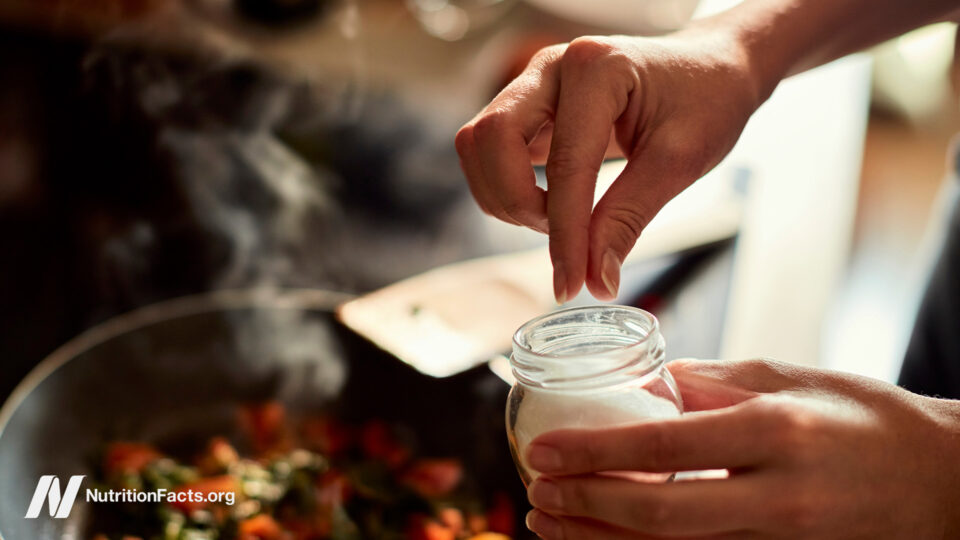
Is potassium chloride a win-win by decreasing sodium intake and increasing potassium intake?
Of all the terrible things about our diets, high dietary sodium intake—high salt intake—is the leading risk. It’s estimated to be causing millions of deaths every year, killing mainly through adverse effects on blood pressure and increased risk of stroke, heart attack, and kidney damage. Hypertension (high blood pressure) is still called the “silent and invisible killer” because it rarely causes symptoms
0
0
The Mineral Intake Recommendations Only 1 in 6,000 U.S. Adults Meet
A staggering 99.99% of Americans fail to get the minimum recommended potassium intake (despite it being perhaps only half of our natural intake) and stay below the recommended sodium intake (even though it may be twice our natural intake).
Worldwide, physical inactivity accounts for more than 10 million years of healthy life lost, but what we eat accounts for nearly 20 times that. Unhealthy diets shave hundreds of millions of disability-free years off people’s lives every year.
What are the wors
0
0
Do Cranberries and Pumpkin Seeds Help an Enlarged Prostate?
Cranberries and pumpkin seeds are put to the test for benign prostatic hypertrophy.
More than 50% of men in their 50s and at least 70% of men over age 60 suffer from benign prostatic hypertrophy, or BPH, otherwise known as enlarged prostate. This can result in burdensome lower urinary tract symptoms, such as having to get up frequently at night to pee. While current medical treatments are clinically effective, side effects and low compliance rates compromise their efficacy. Symptoms include sexu
0
5
The Science Behind Oatmeal and Diabetes
Before Insulin, There Was Oatmeal
Before the discovery of insulin, the lives of many people with diabetes were saved or prolonged by Carl von Noorden’s oatmeal diet. As I discuss in my video Is Oatmeal Good for People with Diabetes?, he published his findings in 1903, which were received with a great deal of skepticism. But the critics were overcome in the following years by the weight of the evidence.
Acclaimed doctor James B. Herrick began to try the oatmeal diet on his patients. Initially ver
0
5
A Surprising Vegetable Approach to Insomnia
Lactucin, the hypnotic component of lettuce, is put to the test in a randomized, double-blind, placebo-controlled trial of lettuce seeds.
“There is a perception that time spent asleep is time wasted,” but it’s widely recognized that insufficient sleep is linked to multiple acute and chronic conditions and increases the risks of death and disease.
As I discuss in my video Natural Dietary Remedy for Insomnia, forcing people to get only six hours of sleep per night for one week can change the expre
0
0
Protect Your Arteries from Saturated Fat with These Foods
If you’re going to have something unhealthy, is there anything you can eat with it to help mitigate the damage it may cause?
If you compare the artery function of vegetarians and meat-eaters, the healthy ability of arteries to dilate and let more blood flow is significantly better among those eating a vegetarian diet. And not just by a little—we’re talking four times better, as you can see below and at 0:24 in my video Foods to Help Protect Your Arteries from Saturated Fat.
Vegetarians do tend
0
2
Can Exercise Counteract a High-Fat Meal?
There is a window of time in which sufficient physical activity can help mediate some of the damage caused by eating an unhealthy meal.
I’ve previously discussed studies that show a single meal high in saturated fat can impair artery function in men, as measured in the arm, but what is more concerning is blood flow to the wall of the heart. Researchers randomized men to eat either a high-fat meal that was more than 60% fat, half of it saturated, with more than an egg’s worth of cholesterol, or a
0
2
How a Single Meal Can Cripple Your Arteries and Lungs
What happens within hours of eating a high-fat meal?
We are only as old as our arteries. What can we do to preserve arterial function as we age? A poor diet and sedentary behavior can lead to adverse aging processes, like impairment of the little power plants in our cells, which can result in free radical formation, oxidative stress, and inflammation, which lead to the artery dysfunction that can end in cardiovascular disease that ends us.
In a series of videos I did about a decade ago, I discus
0
2
What Is the Best Poop Position?
The Squatty Potty is put to the test.
Previously, I’ve talked about the potential efficacy of prunes and dried figs to keep us regular. What influence does body position have on defecation? While squatting continues to be the traditional position for people in Asia and Africa, Westerners have become accustomed to sitting on toilet seats. When we do that, we sit upright, and our poop is forced to make a nearly 90-degree turn, the “anorectal angle,” which you can see below and at 0:37 in my video T
0
1
Can Ultra-Processed Foods Be Fixed by Tweaking Their Nutrients?
What happened when ultra-processed foods were matched for calories, sugar, fat, and fiber content in the first randomized controlled trial?
In the United States, “junk food” is often used to describe less-healthy foods, like candy, ice cream, and chips, but there isn’t a consistent definition, so nutrition researchers came up with the concept of ultra-processed.
The term “ultra-processed food”—if you want to call it that—describes industrial formulations that are typically seen in those long list
0
1
How the Fight to Ban Trans Fat Was Won
What was the secret to the public health community’s triumph when past attempts to regulate the food industry failed?
There are three broad approaches to mediating the ruin of risky choices: inform people (like using labeling), nudge people (for example, by offering financial incentives), or directly intervene to make the activity less harmful. Which do you think prevented more car fatalities: mandating driver education, labeling cars about crash risk, or removing the human element altogether by
0
1
Why Healthy Fast-Food Menu Options Can Backfire
Adding a healthy option can actually drive people to make even worse choices, thanks to a mind-blowing glitch of human psychology.
In 2017, and to much fanfare, menu labeling for calorie counts began to be mandated in national chain restaurants. Consumers should have the information needed to make healthy food choices outside the home, right? It makes sense that caloric information on menus will help people limit their food intake to stay within their daily energy needs. But it didn’t work. It t
0
1
Which Beans Best Block the Spread of Cancer?
Which legumes are best at inhibiting the matrix metalloproteinase enzymes that allow cancer to become invasive?
Although we’re spending billions of dollars on fancy new types of chemotherapy, the overflowing sink that is cancer treatment is expected to rise by about 70% over the next two decades because drugs are being used to merely mop up the mess rather than turn off the faucet. You can’t really give drugs to people to prevent cancer because of the side effects and cost, but there is said to
0
2
A Persistent Pesticide Is Linked to Alzheimer’s Risk
How can we avoid the breakdown products of pesticides that may increase the risk of Alzheimer’s disease as much as if you carried APOE e4, the so-called Alzheimer’s gene?
Although there is a growing list of Alzheimer’s disease susceptibility genes, those genes account for less than half of all Alzheimer’s cases. Here is the “single most compelling” piece of data on the potential control we have over the disease: When it comes to identical twins with the exact same genes, if one gets Alzheimer’s,
0
2
How Big Is the Cancer Risk from Processed Meat?
I quantify the risks of colon and rectal cancers from eating bacon, ham, hot dogs, sausage, and lunch meat.
In 2018, arguably the most prestigious cancer research institution in the world, the International Agency for Research on Cancer (IARC), part of the World Health Organization, published its report on processed meat, concluding that foods like bacon, ham, hot dogs, lunch meat, and sausage are cancer-causing, classifying processed meat as a Group 1 carcinogen. “These findings,” concluded the
0
2
The Backlash to IARC’s Report that Meat Probably Causes Cancer
How did the meat industry, government, and cancer organizations respond to the confirmation that processed meat, like bacon, ham, hot dogs, and lunch meat, causes cancer?
“It is rare, in the history of nations, that one finds good reasons to render homage to the generosity and altruism of governments and those in power: the birth of the International Agency for Research on Cancer [IARC] presents one of those rare occasions.” It all started with a single letter from a grieving husband, relating h
0
2
Is Personalized Genetic Testing Worth It?
Overrated “precision medicine” may just be serving vested interests, and consumer DNA testing can be useless—or even worse.
Today, you can get your DNA sequenced—the letters of your entire genetic code spelled out—for about a thousand dollars, a bargain compared to the $100 million or so it cost 20 years ago. And for around a hundred dollars, you can get partial DNA sequencing. Direct-to-consumer genetic testing is “only a click away,” like 23andMe, for “ancestry, health, love…and more.” Unfortu
0
2
Are Nuts and Peanut Butter Linked to a Longer Life?
Why are nuts associated with decreased mortality, but not peanut butter?
According to the largest study of risk factors for death in human history, a poor diet causes more deaths than anything. Cigarettes only kill about 8 million people a year, whereas humanity’s diet kills millions more, as you can see below and at 0:20 in my video Do the Health Benefits of Peanut Butter Include Longevity?.What are the worst aspects of our diet? Processed meat? Twinkies? Soda? No, the five deadliest things abo
0
4
The Protein Debate: Why Source Matters More Than Amount
I discuss a public health case for modernizing the definition of protein quality.
In 2019, Dr. David Katz and colleagues
0
0
Are Potassium Chloride Salt Substitutes Safe and Effective?
Healthy kidneys are required for potassium excretion. If you aren’t sure if you’re at risk, ask your doctor about gettin
0
0
Are Potassium Chloride Salt Substitutes Worth Trying?
Is potassium chloride a win-win by decreasing sodium intake and increasing potassium intake?
Of all the terrible things
0
0
The Mineral Intake Recommendations Only 1 in 6,000 U.S. Adults Meet
A staggering 99.99% of Americans fail to get the minimum recommended potassium intake (despite it being perhaps only hal
0
0
Do Cranberries and Pumpkin Seeds Help an Enlarged Prostate?
Cranberries and pumpkin seeds are put to the test for benign prostatic hypertrophy.
More than 50% of men in their 50s an
0
5
The Science Behind Oatmeal and Diabetes
Before Insulin, There Was Oatmeal
Before the discovery of insulin, the lives of many people with diabetes were saved or
0
5
A Surprising Vegetable Approach to Insomnia
Lactucin, the hypnotic component of lettuce, is put to the test in a randomized, double-blind, placebo-controlled trial
0
0
Protect Your Arteries from Saturated Fat with These Foods
If you’re going to have something unhealthy, is there anything you can eat with it to help mitigate the damage it may ca
0
2
Can Exercise Counteract a High-Fat Meal?
There is a window of time in which sufficient physical activity can help mediate some of the damage caused by eating an
0
2
How a Single Meal Can Cripple Your Arteries and Lungs
What happens within hours of eating a high-fat meal?
We are only as old as our arteries. What can we do to preserve arte
0
2
What Is the Best Poop Position?
The Squatty Potty is put to the test.
Previously, I’ve talked about the potential efficacy of prunes and dried figs to k
0
1
Can Ultra-Processed Foods Be Fixed by Tweaking Their Nutrients?
What happened when ultra-processed foods were matched for calories, sugar, fat, and fiber content in the first randomized
0
1
How the Fight to Ban Trans Fat Was Won
What was the secret to the public health community’s triumph when past attempts to regulate the food industry failed?
Th
0
1
Why Healthy Fast-Food Menu Options Can Backfire
Adding a healthy option can actually drive people to make even worse choices, thanks to a mind-blowing glitch of human p
0
1
Which Beans Best Block the Spread of Cancer?
Which legumes are best at inhibiting the matrix metalloproteinase enzymes that allow cancer to become invasive?
Although
0
2
A Persistent Pesticide Is Linked to Alzheimer’s Risk
How can we avoid the breakdown products of pesticides that may increase the risk of Alzheimer’s disease as much as if yo
0
2
How Big Is the Cancer Risk from Processed Meat?
I quantify the risks of colon and rectal cancers from eating bacon, ham, hot dogs, sausage, and lunch meat.
In 2018, arg
0
2
The Backlash to IARC’s Report that Meat Probably Causes Cancer
How did the meat industry, government, and cancer organizations respond to the confirmation that processed meat, like ba
0
2
The Protein Debate: Why Source Matters More Than Amount
I discuss a public health case for modernizing the definition of protein quality.
In 2019, Dr. David Katz and colleagues, including one of my favorite researchers, David Jenkins, published a “public health case for modernizing the definition of protein quality.” The prevailing definition seems to have more to do with biochemistry than the overall effects on human health. The common belief that protein is “good,” and the more the better, combined with a definition of protein quality that favors ani
0
0 👁
Are Potassium Chloride Salt Substitutes Safe and Effective?
Healthy kidneys are required for potassium excretion. If you aren’t sure if you’re at risk, ask your doctor about getting your kidney function tested.
Based on how we evolved, the optimum dietary potassium intake likely greatly exceeds current and even recommended intakes. The problem is we replaced many of the potassium-rich plant foods that used to fill our diets—fruits, vegetables, leafy greens, roots, tubers—with calorie-dense junk heavy with added fats and sugars, and stripped not only of f
0
0 👁
Are Potassium Chloride Salt Substitutes Worth Trying?
Is potassium chloride a win-win by decreasing sodium intake and increasing potassium intake?
Of all the terrible things about our diets, high dietary sodium intake—high salt intake—is the leading risk. It’s estimated to be causing millions of deaths every year, killing mainly through adverse effects on blood pressure and increased risk of stroke, heart attack, and kidney damage. Hypertension (high blood pressure) is still called the “silent and invisible killer” because it rarely causes symptoms
0
0 👁
The Mineral Intake Recommendations Only 1 in 6,000 U.S. Adults Meet
A staggering 99.99% of Americans fail to get the minimum recommended potassium intake (despite it being perhaps only half of our natural intake) and stay below the recommended sodium intake (even though it may be twice our natural intake).
Worldwide, physical inactivity accounts for more than 10 million years of healthy life lost, but what we eat accounts for nearly 20 times that. Unhealthy diets shave hundreds of millions of disability-free years off people’s lives every year.
What are the wors
0
0 👁
Do Cranberries and Pumpkin Seeds Help an Enlarged Prostate?
Cranberries and pumpkin seeds are put to the test for benign prostatic hypertrophy.
More than 50% of men in their 50s and at least 70% of men over age 60 suffer from benign prostatic hypertrophy, or BPH, otherwise known as enlarged prostate. This can result in burdensome lower urinary tract symptoms, such as having to get up frequently at night to pee. While current medical treatments are clinically effective, side effects and low compliance rates compromise their efficacy. Symptoms include sexu
0
5 👁
The Science Behind Oatmeal and Diabetes
Before Insulin, There Was Oatmeal
Before the discovery of insulin, the lives of many people with diabetes were saved or prolonged by Carl von Noorden’s oatmeal diet. As I discuss in my video Is Oatmeal Good for People with Diabetes?, he published his findings in 1903, which were received with a great deal of skepticism. But the critics were overcome in the following years by the weight of the evidence.
Acclaimed doctor James B. Herrick began to try the oatmeal diet on his patients. Initially ver
0
5 👁
A Surprising Vegetable Approach to Insomnia
Lactucin, the hypnotic component of lettuce, is put to the test in a randomized, double-blind, placebo-controlled trial of lettuce seeds.
“There is a perception that time spent asleep is time wasted,” but it’s widely recognized that insufficient sleep is linked to multiple acute and chronic conditions and increases the risks of death and disease.
As I discuss in my video Natural Dietary Remedy for Insomnia, forcing people to get only six hours of sleep per night for one week can change the expre
0
0 👁
Protect Your Arteries from Saturated Fat with These Foods
If you’re going to have something unhealthy, is there anything you can eat with it to help mitigate the damage it may cause?
If you compare the artery function of vegetarians and meat-eaters, the healthy ability of arteries to dilate and let more blood flow is significantly better among those eating a vegetarian diet. And not just by a little—we’re talking four times better, as you can see below and at 0:24 in my video Foods to Help Protect Your Arteries from Saturated Fat.
Vegetarians do tend
0
2 👁
Can Exercise Counteract a High-Fat Meal?
There is a window of time in which sufficient physical activity can help mediate some of the damage caused by eating an unhealthy meal.
I’ve previously discussed studies that show a single meal high in saturated fat can impair artery function in men, as measured in the arm, but what is more concerning is blood flow to the wall of the heart. Researchers randomized men to eat either a high-fat meal that was more than 60% fat, half of it saturated, with more than an egg’s worth of cholesterol, or a
0
2 👁
How a Single Meal Can Cripple Your Arteries and Lungs
What happens within hours of eating a high-fat meal?
We are only as old as our arteries. What can we do to preserve arterial function as we age? A poor diet and sedentary behavior can lead to adverse aging processes, like impairment of the little power plants in our cells, which can result in free radical formation, oxidative stress, and inflammation, which lead to the artery dysfunction that can end in cardiovascular disease that ends us.
In a series of videos I did about a decade ago, I discus
0
2 👁
What Is the Best Poop Position?
The Squatty Potty is put to the test.
Previously, I’ve talked about the potential efficacy of prunes and dried figs to keep us regular. What influence does body position have on defecation? While squatting continues to be the traditional position for people in Asia and Africa, Westerners have become accustomed to sitting on toilet seats. When we do that, we sit upright, and our poop is forced to make a nearly 90-degree turn, the “anorectal angle,” which you can see below and at 0:37 in my video T
0
1 👁
Can Ultra-Processed Foods Be Fixed by Tweaking Their Nutrients?
What happened when ultra-processed foods were matched for calories, sugar, fat, and fiber content in the first randomized controlled trial?
In the United States, “junk food” is often used to describe less-healthy foods, like candy, ice cream, and chips, but there isn’t a consistent definition, so nutrition researchers came up with the concept of ultra-processed.
The term “ultra-processed food”—if you want to call it that—describes industrial formulations that are typically seen in those long list
0
1 👁
How the Fight to Ban Trans Fat Was Won
What was the secret to the public health community’s triumph when past attempts to regulate the food industry failed?
There are three broad approaches to mediating the ruin of risky choices: inform people (like using labeling), nudge people (for example, by offering financial incentives), or directly intervene to make the activity less harmful. Which do you think prevented more car fatalities: mandating driver education, labeling cars about crash risk, or removing the human element altogether by
0
1 👁
Why Healthy Fast-Food Menu Options Can Backfire
Adding a healthy option can actually drive people to make even worse choices, thanks to a mind-blowing glitch of human psychology.
In 2017, and to much fanfare, menu labeling for calorie counts began to be mandated in national chain restaurants. Consumers should have the information needed to make healthy food choices outside the home, right? It makes sense that caloric information on menus will help people limit their food intake to stay within their daily energy needs. But it didn’t work. It t
0
1 👁
Which Beans Best Block the Spread of Cancer?
Which legumes are best at inhibiting the matrix metalloproteinase enzymes that allow cancer to become invasive?
Although we’re spending billions of dollars on fancy new types of chemotherapy, the overflowing sink that is cancer treatment is expected to rise by about 70% over the next two decades because drugs are being used to merely mop up the mess rather than turn off the faucet. You can’t really give drugs to people to prevent cancer because of the side effects and cost, but there is said to
0
2 👁
A Persistent Pesticide Is Linked to Alzheimer’s Risk
How can we avoid the breakdown products of pesticides that may increase the risk of Alzheimer’s disease as much as if you carried APOE e4, the so-called Alzheimer’s gene?
Although there is a growing list of Alzheimer’s disease susceptibility genes, those genes account for less than half of all Alzheimer’s cases. Here is the “single most compelling” piece of data on the potential control we have over the disease: When it comes to identical twins with the exact same genes, if one gets Alzheimer’s,
0
2 👁
How Big Is the Cancer Risk from Processed Meat?
I quantify the risks of colon and rectal cancers from eating bacon, ham, hot dogs, sausage, and lunch meat.
In 2018, arguably the most prestigious cancer research institution in the world, the International Agency for Research on Cancer (IARC), part of the World Health Organization, published its report on processed meat, concluding that foods like bacon, ham, hot dogs, lunch meat, and sausage are cancer-causing, classifying processed meat as a Group 1 carcinogen. “These findings,” concluded the
0
2 👁
The Backlash to IARC’s Report that Meat Probably Causes Cancer
How did the meat industry, government, and cancer organizations respond to the confirmation that processed meat, like bacon, ham, hot dogs, and lunch meat, causes cancer?
“It is rare, in the history of nations, that one finds good reasons to render homage to the generosity and altruism of governments and those in power: the birth of the International Agency for Research on Cancer [IARC] presents one of those rare occasions.” It all started with a single letter from a grieving husband, relating h
0
2 👁
Is Personalized Genetic Testing Worth It?
Overrated “precision medicine” may just be serving vested interests, and consumer DNA testing can be useless—or even worse.
Today, you can get your DNA sequenced—the letters of your entire genetic code spelled out—for about a thousand dollars, a bargain compared to the $100 million or so it cost 20 years ago. And for around a hundred dollars, you can get partial DNA sequencing. Direct-to-consumer genetic testing is “only a click away,” like 23andMe, for “ancestry, health, love…and more.” Unfortu
0
2 👁
Are Nuts and Peanut Butter Linked to a Longer Life?
Why are nuts associated with decreased mortality, but not peanut butter?
According to the largest study of risk factors for death in human history, a poor diet causes more deaths than anything. Cigarettes only kill about 8 million people a year, whereas humanity’s diet kills millions more, as you can see below and at 0:20 in my video Do the Health Benefits of Peanut Butter Include Longevity?.What are the worst aspects of our diet? Processed meat? Twinkies? Soda? No, the five deadliest things abo
0
4 👁
The Protein Debate: Why Source Matters More Than Amount
I discuss a public health case for modernizing the definition of protein quality.
In 2019, Dr. David Katz and colleagues, includin…
💬 0
👁 0
Are Potassium Chloride Salt Substitutes Safe and Effective?
NutritionFacts.org · 4d ago
💬 0
👁 0
Are Potassium Chloride Salt Substitutes Worth Trying?
NutritionFacts.org · Jul 23, 2026
💬 0
👁 0
The Mineral Intake Recommendations Only 1 in 6,000 U.S. Adults Meet
NutritionFacts.org · Jul 21, 2026
💬 0
👁 0

Do Cranberries and Pumpkin Seeds Help an Enlarged Prostate?
NutritionFacts.org · Jul 16, 2026

The Science Behind Oatmeal and Diabetes
NutritionFacts.org · Jul 14, 2026

A Surprising Vegetable Approach to Insomnia
NutritionFacts.org · Jul 9, 2026

Protect Your Arteries from Saturated Fat with These Foods
NutritionFacts.org · Jul 7, 2026
Can Exercise Counteract a High-Fat Meal?
There is a window of time in which sufficient physical activity can help mediate some of the damage caused by eating an unhealthy …
💬 0
👁 2
How a Single Meal Can Cripple Your Arteries and Lungs
NutritionFacts.org · Jun 30, 2026
💬 0
👁 2
What Is the Best Poop Position?
NutritionFacts.org · Jun 25, 2026
💬 0
👁 1
Can Ultra-Processed Foods Be Fixed by Tweaking Their Nutrients?
NutritionFacts.org · Jun 23, 2026
💬 0
👁 1

How the Fight to Ban Trans Fat Was Won
NutritionFacts.org · Jun 18, 2026

Why Healthy Fast-Food Menu Options Can Backfire
NutritionFacts.org · Jun 16, 2026

Which Beans Best Block the Spread of Cancer?
NutritionFacts.org · Jun 11, 2026

A Persistent Pesticide Is Linked to Alzheimer’s Risk
NutritionFacts.org · Jun 9, 2026
How Big Is the Cancer Risk from Processed Meat?
I quantify the risks of colon and rectal cancers from eating bacon, ham, hot dogs, sausage, and lunch meat.
In 2018, arguably the …
💬 0
👁 2
The Backlash to IARC’s Report that Meat Probably Causes Cancer
NutritionFacts.org · Jun 2, 2026
💬 0
👁 2
Is Personalized Genetic Testing Worth It?
NutritionFacts.org · May 28, 2026
💬 0
👁 2
Are Nuts and Peanut Butter Linked to a Longer Life?
NutritionFacts.org · May 26, 2026
💬 0
👁 4