Latest Articles
Very good news
Michael Kremer picked as World Bank chief economist (Bloomberg). Here are many many previous MR posts on Kremer, of course Alex also worked with him on Operation Warp Speed.
The post Very good news appeared first on Marginal REVOLUTION.
0
9
What Regulatory Capture Actually Looks Like
It’s amazing how a theory can take over a brain. Consider the idea that people believe what serves their interests. As heuristics go, it’s a good one. I use it all the time. Yet when Dario Amodei says AI is dangerous, perhaps even an extinction risk, some people conclude he must be running a marketing campaign. That is stupid. Which is more likely, that a useful heuristic sometimes misfires or that “our product might kill you” is a clever way to sell it? Death threats are
0
8
The economics of cyber risk
From Aniket Baksy and Daniele Caratelli, here is part of the abstract:
Because larger firms are more attractive targets but also invest more in protection, the model generates an inverse-U relationship between firm size and attack risk, consistent with the data. Introducing cyber risk reduces firm entry by 3.6 percent, aggregate productivity by 0.6 percent, and total output by 1.8 percent. These effects arise from general equilibrium adjustments in entry, firm size, and spillovers that are absen
0
7
When discussing AI policy, start with China
Whatever your ideas for regulating AI, I say start with China. Do not put China as an afterthought at the end of your proposal, mentioned in a vague wish that something good ought to happen and that maybe the future of humanity can be secured.
During the 2023 U.S.-China nuclear talks, America proposed missile-launch notifications, a nuclear crisis hotline, and processes to limit the use of outer space for military conflict. China declined all of those. Blame the U.S. if you wish (do we always
0
9
Callum Williams on cybersecurity prices
Share prices of cyber firms have jumped around a lot in recent weeks, leading one side or the other to claim victory. But the crucial point is that, relative to the historical norm, the market is not really pricing ANYTHING big to change. There was a much bigger move in cyber stocks in both 2020-22 (up) and 2022-23 (down) but no one read “AI x-risk” into this.
Here is the full post with graph.
Hardly the final word, and I am myself more pessimistic than those numbers indicate. But
0
8
Tuesday assorted links
1. Easy to bioengineer a very dangerous virus?
2. The astrophysicists are getting antsy too. Princeton is also getting nervous. If nothing else, these are huge PR own goals. The guy is a Mill scholars, can you imagine J.S. Mill tweeting that way?
3. New David Brooks podcast.
4. One Chinese view of AI risk. And from Richard Hanania.
5. Arnold Kling on Polanyi knowledge.
6. Jeremy Stern profile of Mark Zuckerberg. Great piece.
7. China’s first AI-generated TV series.
8. Introducing Free
0
8
The striking thing is how late the market moved
Here’s the S&P 500 (daily close) with the key COVID and policy events marked; the numbered key is below the chart.
Event key:
Dec 31 – China reports the Wuhan pneumonia cluster to the WHO
Jan 21 – First confirmed US case (Washington state)
Jan 23 – Wuhan locked down
Jan 30 – WHO declares a global health emergency (PHEIC)
Feb 19 – S&P 500 all-time high, 3,386
Feb 24 – Italy outbreak; first big US selloff
Mar 3 – Fed emergency 50 bp cut
Mar 11 – WHO declares pandemic; Europe travel
0
6
Those new service sector jobs
Horwitz is in the business of playing a version of mom for local college students. Concierge companies offering student support have existed for decades. But in recent years, a new crop of upstarts — such as Horwitz’s company, MindyKnows; the Bama Mama in Alabama; the GA Mom in Georgia; and Campus Mom in Texas — have met additional demand from a new generation of worried parents…
The specific services vary here and there, but share commonalities. Campus Mom offers “holistic wellness check-
0
6
Did the ACA reduce mortality?
Many of us brought up related points at the time, but basically we were booed off the reservation:
While recent research has provided evidence that the Medicaid expansions of the Affordable Care Act (ACA) reduced mortality, there is no evidence on the effect of the Affordable Care Act (ACA) net of the Medicaid expansions on mortality. This is an important gap in knowledge because the ACA significantly increased health insurance coverage in non-expansion states. In this article, we exploit the la
0
6
Monday assorted links
1. Will driverless cars increase or reduce urban density?
2. One decomposition approach to why interest rates have been going up.
3. New Guinness record holders.
4. Is there any chance of finding Rembrandt DNA?
5. “Abundance Corps is hosting Making Progress, a private gathering for students interested in how science, technology, and institutions can improve people’s lives.”
6. High school students plus AI solve math problem.
7. “China’s top spy chief has warned that artificial
0
6
AI, Redistribution, and the Size of the Pie
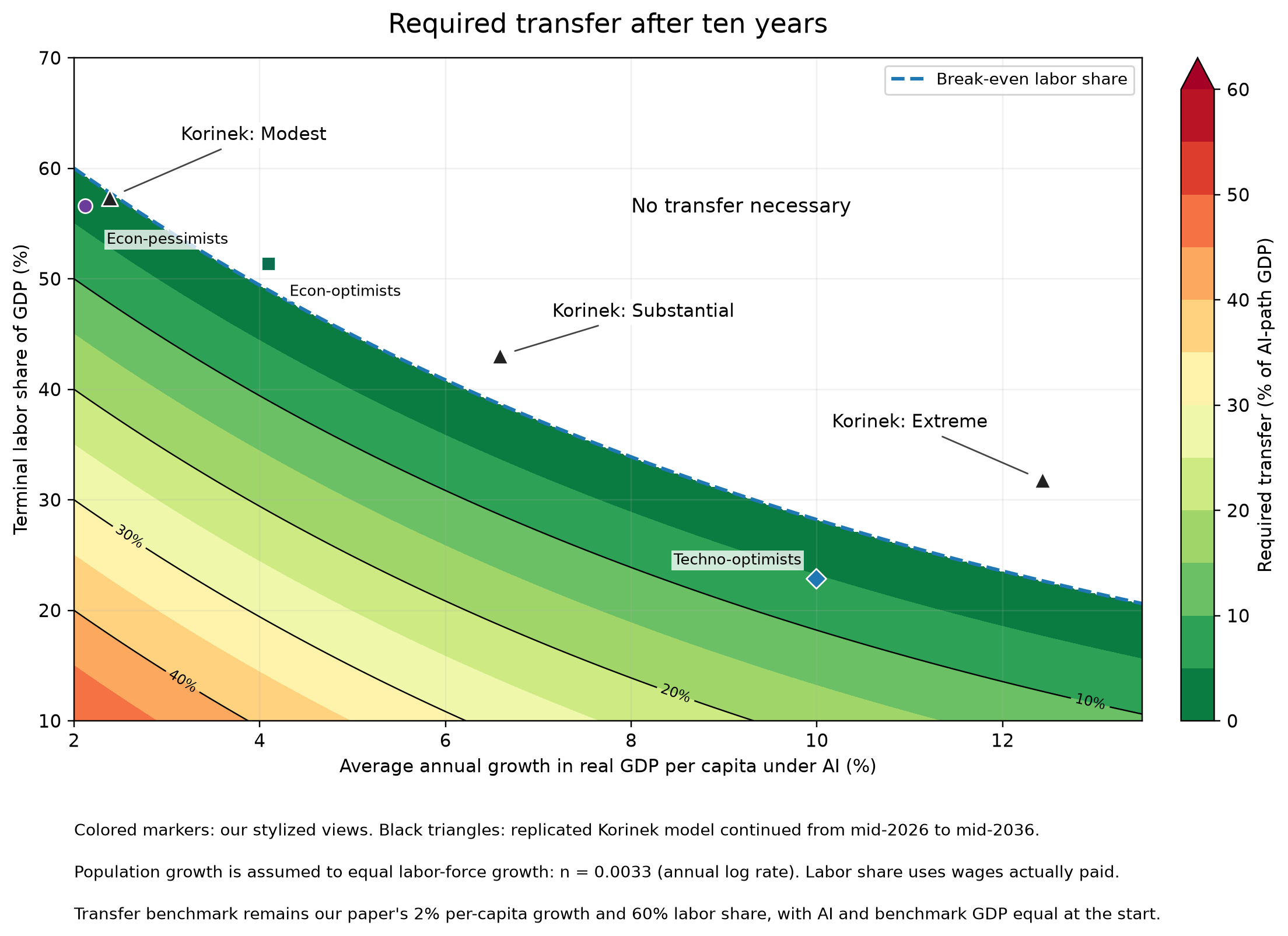
Anthropic’s economic team, including Anton Korinek and Chad Jones, have a valuable new paper, Economic Scenarios for Transformative AI. They make their assumptions explicit and provide a scenario explorer that lets you change them. How capable will AI become? How quickly will firms adopt it? Will it augment workers or automate their tasks? You can see what different answers imply for growth, wages, and unemployment.
In their extreme scenario AI takes on a lot of tasks, GDP is 32.4% higher
0
5
Is it the screens? Or education systems?
The Dark Ages implies television and phones are the main cause of cognitive decline. This fails to explain the patterns in PISA scores. Why did England and Scotland fall so precipitously from 2000 to 2005 whilst America improved? Why did England and Estonia hold steady after 2015 whilst most other OECD countries declined? How have Singapore, Taiwan, Japan avoided decline altogether?
A better explanation is that a country’s education system is more important than its television diffusion.1 East A
0
7
Does AI assistance enhance or erode expertise?
From a new NBER working paper:
Whether AI assistance builds or erodes professional expertise is unsettled. In a pre-registered three-month randomized controlled trial, we gave 133 practicing patent lawyers at eleven U.S. intellectual property law firms access to a custom AI drafting assistant and measured both their performance while using AI and their professional judgment afterward without it. All work was scored by blinded expert patent attorneys. Paralleling findings from other white-collar
0
6
Sunday assorted links
1. Scott Sumner as regional thinker.
2. The economists who work on “Productivity and Innovation” are most likely to use AI for their writing.
3. Michael Levin defends neo-neo-Platonism?
4. Look for and try to limit agent collusion.
5. Do orangutans like Indian classical music?
6. “Our results demonstrate that LLM-evolved constitutions significantly outperform both human-designed principles and one-shot LLM-generated rules for multi-agent coordination.“
The post Sunday ass
0
6
Diversity Is Our Strength?
Diversity is our strength is a common motto. Indeed it is one of GMU’s core values but what is the scientific evidence for this thesis? A new scoping review:
Recent years have witnessed many strong claims that ‘diversity’ leads to more original and impactful science, which is a science-focused form of what we call “The Diversity Hypothesis.” However, what evidence supports the claim that diversity enhances scientific output or impact? This pre-registered rapid scoping review seeks to colla
0
6
Wednesday assorted links
1. Crime and drunkenness map of England and Wales (that was then, this is now).
2. Cesar Aira says he will stop writing.
3. Toward a post-cultural state?
4. Madrid has great PISA scores.
5. Firms as foragers.
6. Asimov Press is back.
The post Wednesday assorted links appeared first on Marginal REVOLUTION.
0
8
Next Wins Appeal
A spot of good news for Britain. Next has won its appeal and may go on paying warehouse workers more than “equal value” retail workers. I’ve written about this case in Equality Act 2010, The Equal Pay Madness Just Got Madder and The Apples and Oranges Tribunal, and discussed it at length on the CapX podcast.
Note how crazy the headline is:
The landmark ruling allows the retailer to pay warehouse workers more than shop staff on the basis it costs more to recruit and retain them.
0
10
Reading sentences to ponder
In 2015, 6 of the top 25 bestselling hardcover books—this is a not-perfect but useful proxy for new books published—were fiction. In 2025, 18 of the top 25 hardcover books were fiction, meaning only 7 were nonfiction, almost an exact inversion of ten years ago.
From Sean Delone, via David Wallace-Wells.
The post Reading sentences to ponder appeared first on Marginal REVOLUTION.
0
12
Reasons to go to college
That is the topic of my latest Free Press column, here is one excerpt:
…college is a great place to make friends, date, and possibly meet a spouse. Those features are ever more important as America suffers a crisis of loneliness. Furthermore, if you think that artificial intelligence may displace a lot of jobs, or just reduce work hours, marrying well will become more important. The title of the new essay by Clara Collier says it all: “After Work, We’ll Have Each Other.” You are also going
0
6
Tuesday assorted links
1. The Carob Prize, for scholars who tell the truth (WSJ).
2. Observations from watching Iranian social media.
3. The Emma McAleavy feminist vision.
4. Is the inflation picture shifting?
5. The labor market is doing fine.
6. If LLMs had the personalities of TV stars, would you choose Colombo?
The post Tuesday assorted links appeared first on Marginal REVOLUTION.
0
6
Very good news
Michael Kremer picked as World Bank chief economist (Bloomberg). Here are many many previous MR posts on Kremer, of cou
0
9
What Regulatory Capture Actually Looks Like
It’s amazing how a theory can take over a brain. Consider the idea that people believe what serves their interests
0
8
The economics of cyber risk
From Aniket Baksy and Daniele Caratelli, here is part of the abstract:
Because larger firms are more attractive targets
0
7
When discussing AI policy, start with China
Whatever your ideas for regulating AI, I say start with China. Do not put China as an afterthought at the end of your p
0
9
Callum Williams on cybersecurity prices
Share prices of cyber firms have jumped around a lot in recent weeks, leading one side or the other to claim victory. Bu
0
8
Tuesday assorted links
1. Easy to bioengineer a very dangerous virus?
2. The astrophysicists are getting antsy too. Princeton is also getting
0
8
The striking thing is how late the market moved
Here’s the S&P 500 (daily close) with the key COVID and policy events marked; the numbered key is below the ch
0
6
Those new service sector jobs
Horwitz is in the business of playing a version of mom for local college students. Concierge companies offering student
0
6
Did the ACA reduce mortality?
Many of us brought up related points at the time, but basically we were booed off the reservation:
While recent research
0
6
Monday assorted links
1. Will driverless cars increase or reduce urban density?
2. One decomposition approach to why interest rates have been
0
6
AI, Redistribution, and the Size of the Pie
Anthropic’s economic team, including Anton Korinek and Chad Jones, have a valuable new paper, Economic Scenarios f
0
5
Is it the screens? Or education systems?
The Dark Ages implies television and phones are the main cause of cognitive decline. This fails to explain the patterns
0
7
Does AI assistance enhance or erode expertise?
From a new NBER working paper:
Whether AI assistance builds or erodes professional expertise is unsettled. In a pre-regi
0
6
Sunday assorted links
1. Scott Sumner as regional thinker.
2. The economists who work on “Productivity and Innovation” are most li
0
6
Diversity Is Our Strength?
Diversity is our strength is a common motto. Indeed it is one of GMU’s core values but what is the scientific evid
0
6
Wednesday assorted links
1. Crime and drunkenness map of England and Wales (that was then, this is now).
2. Cesar Aira says he will stop writing.
0
8
Next Wins Appeal
A spot of good news for Britain. Next has won its appeal and may go on paying warehouse workers more than “equal v
0
10
Reading sentences to ponder
In 2015, 6 of the top 25 bestselling hardcover books—this is a not-perfect but useful proxy for new books published—were
0
12
Very good news
Michael Kremer picked as World Bank chief economist (Bloomberg). Here are many many previous MR posts on Kremer, of course Alex also worked with him on Operation Warp Speed.
The post Very good news appeared first on Marginal REVOLUTION.
0
9 👁
What Regulatory Capture Actually Looks Like
It’s amazing how a theory can take over a brain. Consider the idea that people believe what serves their interests. As heuristics go, it’s a good one. I use it all the time. Yet when Dario Amodei says AI is dangerous, perhaps even an extinction risk, some people conclude he must be running a marketing campaign. That is stupid. Which is more likely, that a useful heuristic sometimes misfires or that “our product might kill you” is a clever way to sell it? Death threats are
0
8 👁
The economics of cyber risk
From Aniket Baksy and Daniele Caratelli, here is part of the abstract:
Because larger firms are more attractive targets but also invest more in protection, the model generates an inverse-U relationship between firm size and attack risk, consistent with the data. Introducing cyber risk reduces firm entry by 3.6 percent, aggregate productivity by 0.6 percent, and total output by 1.8 percent. These effects arise from general equilibrium adjustments in entry, firm size, and spillovers that are absen
0
7 👁
When discussing AI policy, start with China
Whatever your ideas for regulating AI, I say start with China. Do not put China as an afterthought at the end of your proposal, mentioned in a vague wish that something good ought to happen and that maybe the future of humanity can be secured.
During the 2023 U.S.-China nuclear talks, America proposed missile-launch notifications, a nuclear crisis hotline, and processes to limit the use of outer space for military conflict. China declined all of those. Blame the U.S. if you wish (do we always
0
9 👁
Callum Williams on cybersecurity prices
Share prices of cyber firms have jumped around a lot in recent weeks, leading one side or the other to claim victory. But the crucial point is that, relative to the historical norm, the market is not really pricing ANYTHING big to change. There was a much bigger move in cyber stocks in both 2020-22 (up) and 2022-23 (down) but no one read “AI x-risk” into this.
Here is the full post with graph.
Hardly the final word, and I am myself more pessimistic than those numbers indicate. But
0
8 👁
Tuesday assorted links
1. Easy to bioengineer a very dangerous virus?
2. The astrophysicists are getting antsy too. Princeton is also getting nervous. If nothing else, these are huge PR own goals. The guy is a Mill scholars, can you imagine J.S. Mill tweeting that way?
3. New David Brooks podcast.
4. One Chinese view of AI risk. And from Richard Hanania.
5. Arnold Kling on Polanyi knowledge.
6. Jeremy Stern profile of Mark Zuckerberg. Great piece.
7. China’s first AI-generated TV series.
8. Introducing Free
0
8 👁
The striking thing is how late the market moved
Here’s the S&P 500 (daily close) with the key COVID and policy events marked; the numbered key is below the chart.
Event key:
Dec 31 – China reports the Wuhan pneumonia cluster to the WHO
Jan 21 – First confirmed US case (Washington state)
Jan 23 – Wuhan locked down
Jan 30 – WHO declares a global health emergency (PHEIC)
Feb 19 – S&P 500 all-time high, 3,386
Feb 24 – Italy outbreak; first big US selloff
Mar 3 – Fed emergency 50 bp cut
Mar 11 – WHO declares pandemic; Europe travel
0
6 👁
Those new service sector jobs
Horwitz is in the business of playing a version of mom for local college students. Concierge companies offering student support have existed for decades. But in recent years, a new crop of upstarts — such as Horwitz’s company, MindyKnows; the Bama Mama in Alabama; the GA Mom in Georgia; and Campus Mom in Texas — have met additional demand from a new generation of worried parents…
The specific services vary here and there, but share commonalities. Campus Mom offers “holistic wellness check-
0
6 👁
Did the ACA reduce mortality?
Many of us brought up related points at the time, but basically we were booed off the reservation:
While recent research has provided evidence that the Medicaid expansions of the Affordable Care Act (ACA) reduced mortality, there is no evidence on the effect of the Affordable Care Act (ACA) net of the Medicaid expansions on mortality. This is an important gap in knowledge because the ACA significantly increased health insurance coverage in non-expansion states. In this article, we exploit the la
0
6 👁
Monday assorted links
1. Will driverless cars increase or reduce urban density?
2. One decomposition approach to why interest rates have been going up.
3. New Guinness record holders.
4. Is there any chance of finding Rembrandt DNA?
5. “Abundance Corps is hosting Making Progress, a private gathering for students interested in how science, technology, and institutions can improve people’s lives.”
6. High school students plus AI solve math problem.
7. “China’s top spy chief has warned that artificial
0
6 👁
AI, Redistribution, and the Size of the Pie
Anthropic’s economic team, including Anton Korinek and Chad Jones, have a valuable new paper, Economic Scenarios for Transformative AI. They make their assumptions explicit and provide a scenario explorer that lets you change them. How capable will AI become? How quickly will firms adopt it? Will it augment workers or automate their tasks? You can see what different answers imply for growth, wages, and unemployment.
In their extreme scenario AI takes on a lot of tasks, GDP is 32.4% higher
0
5 👁
Is it the screens? Or education systems?
The Dark Ages implies television and phones are the main cause of cognitive decline. This fails to explain the patterns in PISA scores. Why did England and Scotland fall so precipitously from 2000 to 2005 whilst America improved? Why did England and Estonia hold steady after 2015 whilst most other OECD countries declined? How have Singapore, Taiwan, Japan avoided decline altogether?
A better explanation is that a country’s education system is more important than its television diffusion.1 East A
0
7 👁
Does AI assistance enhance or erode expertise?
From a new NBER working paper:
Whether AI assistance builds or erodes professional expertise is unsettled. In a pre-registered three-month randomized controlled trial, we gave 133 practicing patent lawyers at eleven U.S. intellectual property law firms access to a custom AI drafting assistant and measured both their performance while using AI and their professional judgment afterward without it. All work was scored by blinded expert patent attorneys. Paralleling findings from other white-collar
0
6 👁
Sunday assorted links
1. Scott Sumner as regional thinker.
2. The economists who work on “Productivity and Innovation” are most likely to use AI for their writing.
3. Michael Levin defends neo-neo-Platonism?
4. Look for and try to limit agent collusion.
5. Do orangutans like Indian classical music?
6. “Our results demonstrate that LLM-evolved constitutions significantly outperform both human-designed principles and one-shot LLM-generated rules for multi-agent coordination.“
The post Sunday ass
0
6 👁
Diversity Is Our Strength?
Diversity is our strength is a common motto. Indeed it is one of GMU’s core values but what is the scientific evidence for this thesis? A new scoping review:
Recent years have witnessed many strong claims that ‘diversity’ leads to more original and impactful science, which is a science-focused form of what we call “The Diversity Hypothesis.” However, what evidence supports the claim that diversity enhances scientific output or impact? This pre-registered rapid scoping review seeks to colla
0
6 👁
Wednesday assorted links
1. Crime and drunkenness map of England and Wales (that was then, this is now).
2. Cesar Aira says he will stop writing.
3. Toward a post-cultural state?
4. Madrid has great PISA scores.
5. Firms as foragers.
6. Asimov Press is back.
The post Wednesday assorted links appeared first on Marginal REVOLUTION.
0
8 👁
Next Wins Appeal
A spot of good news for Britain. Next has won its appeal and may go on paying warehouse workers more than “equal value” retail workers. I’ve written about this case in Equality Act 2010, The Equal Pay Madness Just Got Madder and The Apples and Oranges Tribunal, and discussed it at length on the CapX podcast.
Note how crazy the headline is:
The landmark ruling allows the retailer to pay warehouse workers more than shop staff on the basis it costs more to recruit and retain them.
0
10 👁
Reading sentences to ponder
In 2015, 6 of the top 25 bestselling hardcover books—this is a not-perfect but useful proxy for new books published—were fiction. In 2025, 18 of the top 25 hardcover books were fiction, meaning only 7 were nonfiction, almost an exact inversion of ten years ago.
From Sean Delone, via David Wallace-Wells.
The post Reading sentences to ponder appeared first on Marginal REVOLUTION.
0
12 👁
Reasons to go to college
That is the topic of my latest Free Press column, here is one excerpt:
…college is a great place to make friends, date, and possibly meet a spouse. Those features are ever more important as America suffers a crisis of loneliness. Furthermore, if you think that artificial intelligence may displace a lot of jobs, or just reduce work hours, marrying well will become more important. The title of the new essay by Clara Collier says it all: “After Work, We’ll Have Each Other.” You are also going
0
6 👁
Tuesday assorted links
1. The Carob Prize, for scholars who tell the truth (WSJ).
2. Observations from watching Iranian social media.
3. The Emma McAleavy feminist vision.
4. Is the inflation picture shifting?
5. The labor market is doing fine.
6. If LLMs had the personalities of TV stars, would you choose Colombo?
The post Tuesday assorted links appeared first on Marginal REVOLUTION.
0
6 👁
Very good news
Michael Kremer picked as World Bank chief economist (Bloomberg). Here are many many previous MR posts on Kremer, of course Alex a…
💬 0
👁 9
What Regulatory Capture Actually Looks Like
Marginal REVOLUTION · Sep 16, 2026
💬 0
👁 8
The economics of cyber risk
Marginal REVOLUTION · Sep 16, 2026
💬 0
👁 7
When discussing AI policy, start with China
Marginal REVOLUTION · Sep 16, 2026
💬 0
👁 9
Callum Williams on cybersecurity prices
Marginal REVOLUTION · Sep 15, 2026
Tuesday assorted links
Marginal REVOLUTION · Sep 15, 2026

The striking thing is how late the market moved
Marginal REVOLUTION · Sep 15, 2026
Those new service sector jobs
Marginal REVOLUTION · Sep 15, 2026
Did the ACA reduce mortality?
Many of us brought up related points at the time, but basically we were booed off the reservation:
While recent research has provi…
💬 0
👁 6
Monday assorted links
Marginal REVOLUTION · Sep 14, 2026
💬 0
👁 6
AI, Redistribution, and the Size of the Pie
Marginal REVOLUTION · Sep 14, 2026
💬 0
👁 5
Is it the screens? Or education systems?
Marginal REVOLUTION · Sep 14, 2026
💬 0
👁 7
Does AI assistance enhance or erode expertise?
Marginal REVOLUTION · Sep 14, 2026
Sunday assorted links
Marginal REVOLUTION · Sep 13, 2026
Diversity Is Our Strength?
Marginal REVOLUTION · Sep 13, 2026
Wednesday assorted links
Marginal REVOLUTION · Sep 9, 2026
Next Wins Appeal
A spot of good news for Britain. Next has won its appeal and may go on paying warehouse workers more than “equal value”…
💬 0
👁 10