Climate science and policy
Latest Articles
DeBriefed 2 April 2026: Countries ‘revive’ energy-crisis measures | Record UK renewables | Plug-in solar savings
Welcome to Carbon Brief’s DeBriefed. An essential guide to the week’s key developments relating to climate change.
This week
Crisis responses
OIL SUPPLIES: The International Energy Agency (IEA) warned that oil supply disruptions will worsen in April due to the Iran war, reported CNBC. The outlet added that the IEA was considering another release of strategic oil reserves. Meanwhile, US exports of liquefied natural gas (LNG) reached an “all-time high” in March, with shipments
0
0
Analysis: Record wind and solar saved UK from gas imports worth £1bn in March 2026
The UK avoided the need for gas imports worth £1bn in March 2026 thanks to record electricity generation from wind and solar, reveals Carbon Brief analysis.
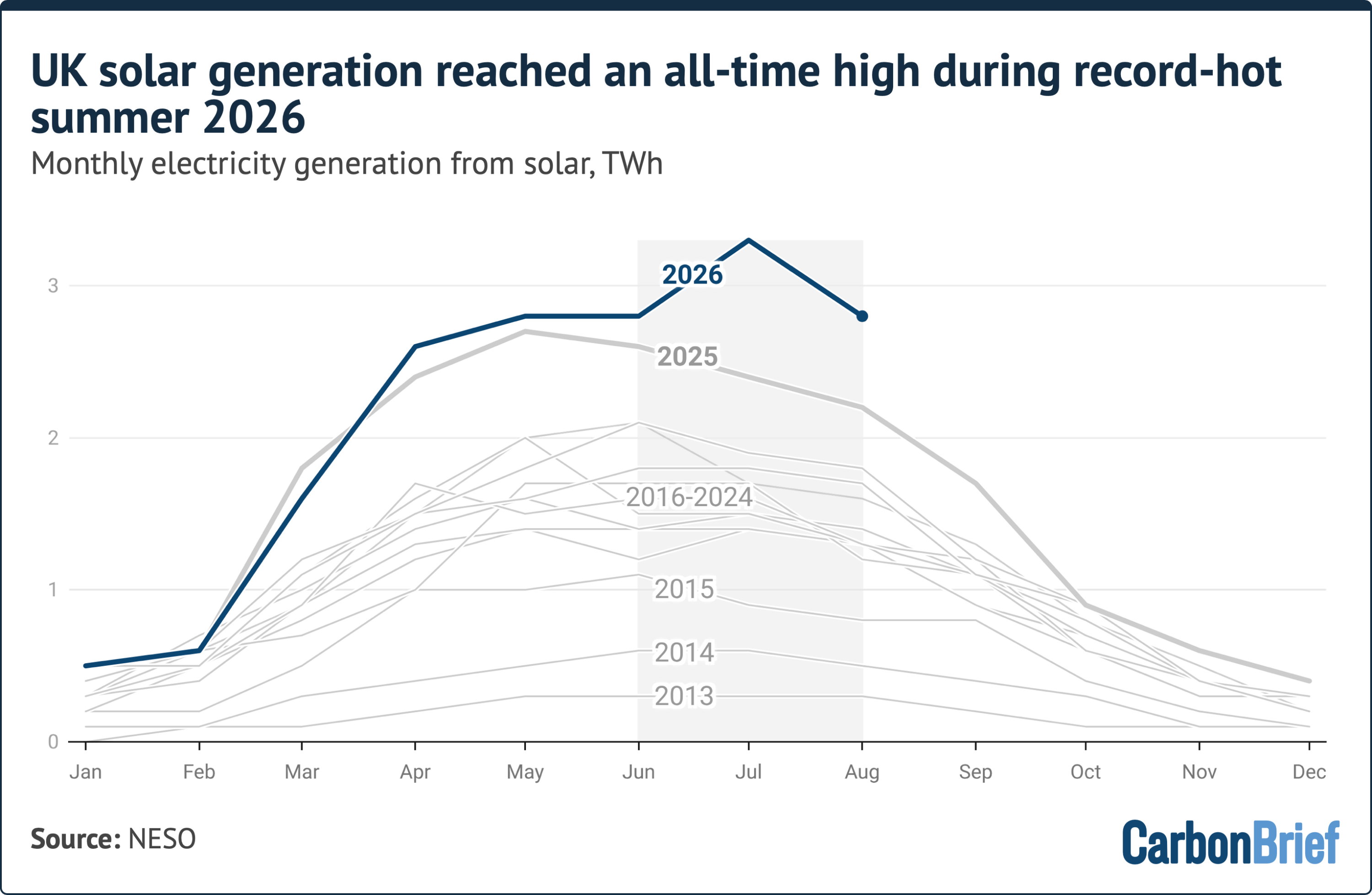
Wind generation hit a new record for the month of March on the island of Great Britain, up 38% year-on-year, while solar nearly matched the output of last year’s exceptionally sunny spring.
Together, wind and solar generated 11 terawatt hours (TWh) of electricity in March 2026, up a combined 28% and setting a new record for the month,
0
0
China Briefing 2 April 2026: EV profits rise | Ming Yang rejected | Iran war
Welcome to Carbon Brief’s China Briefing.
China Briefing handpicks and explains the most important climate and energy stories from China over the past fortnight. Subscribe for free here.
Key developments
Climate on agenda at post-two sessions forums
‘UNWAVERING’ ON CLIMATE: “China will “unwaveringly” follow a low-carbon pathway, said environment vice-minister Li Gao at the China Development Forum (CDF) – a high-level and business-focused event traditionally held after China’s tw
0
0
Q&A: Why the standoff between nations over the next IPCC reports matters
The Intergovernmental Panel on Climate Change’s (IPCC) latest assessment cycle has been beset by disagreements between nations over the timeline for publishing its next landmark report.
During the UN climate science body’s last five “sessions” – biannual meetings where governments discuss matters related to the IPCC’s work – governments have been unable to sign off on the delivery date of the “working group” reports.
The deadlock over the delivery plan for the seventh assessmen
0
0
Analysis: How ‘plug-in solar’ can save UK homes £1,100 on energy bills
Plug-in solar panels could save a typical UK household £1,100 over their 15-year lifetime, according to Carbon Brief analysis.
In response to the ongoing energy crisis, the UK government announced on 15 March a package of clean-energy measures to “boost” energy security.
Among these was the introduction of “plug-in” solar panels to the UK, which would be available “within months” at retailers, according to the government.
A cost-benefit analysis by Carbon Brief finds that plug-in solar
0
0
IPCC: ‘Frustrating and disappointing’ meeting leaves AR7 timeline in deadlock
Governments are still at loggerheads over the timeline for publishing the Intergovernmental Panel on Climate Change’s (IPCC) next three-part report, after countries doubled down on existing positions at a meeting in Bangkok.
Last week, around 330 delegates from more than 100 countries met in Thailand for the 64th session (IPCC-64) of the UN’s climate science body.
The meeting, set against the backdrop of a global energy shock triggered by war in the Middle East, comes more than two-a
0
0
How wildfires and storms drove insurance losses in 2025 – in three charts
Extreme weather events around the world, such as wildfires and storms, were the major driver behind $107bn in insured losses in 2025, according to industry data.
The Los Angeles wildfires alone caused record-high $40bn in insured losses from fires, says a new report from reinsurance company Swiss Re.
The report notes that, while overall insured losses in 2025 were lower than previous years, this was due to a “[luck] rather than a reduction in risk”, partly due to no major hurri
0
0
DeBriefed 27 Mach 2026: North Sea myths debunked | India’s climate plan | IPCC and Indigenous knowledge
Welcome to Carbon Brief’s DeBriefed. An essential guide to the week’s key developments relating to climate change.
This week
Hormuz latest
DELAYED ULTIMATUM: The week started with US president Donald Trump giving Iran 48 hours to reopen the Strait of Hormuz, a vital supply route for oil and gas, or the US would “hit and obliterate” Iranian power plants, reported the Guardian. By the end of the week, Reuters was reporting Trump’s statement that he would “pause” the threa
0
0
‘Very alarming’ winter sees Arctic sea ice hit record-low for second year running
Arctic sea ice has reached its peak extent for this winter, clocking in as the joint-smallest in a satellite record going back almost half a century.
Provisional data from the US National Snow and Ice Data Center (NSIDC) shows that sea ice extent peaked at 14.29m square kilometres (km2) on 15 March.
This is slightly smaller than the previous record for the annual maximum – set just last year – but it counts as a statistical tie, the NSIDC says.
The annual maximum is a key marker in a cy
0
0
Q&A: What does India’s new Paris Agreement pledge mean for climate action?
India has set a new target to reduce its “emissions intensity” – greenhouse gas emissions per unit of economic output – to 47% below 2005 levels by 2035.
The much-awaited announcement comes within India’s delayed new nationally determined contribution (NDC) for 2035 under the Paris Agreement, which had been due last year.
The pledge, which has not yet been published by the UN, was approved by India’s cabinet and issued as a government press release on 25 March.
The updated ND
0
0
Analysis: UK is ‘halving’ its climate finance for developing countries
The UK is roughly halving the climate aid it allocates to developing countries, when accounting changes and inflation are factored in, according to new analysis by Carbon Brief.
On 19 March, the government announced that the UK would provide “around £6bn” of international “climate finance” over the next three years.
This replaces a previous goal to provide £11.6bn across the 2021-2026 period to help nations in the global south cut their emissions and deal with climate threats.
The new t
0
0
Guest post: How declining cloudiness is accelerating global warming
For the past two decades, low-level cloud cover has been declining, increasing the amount of sunlight absorbed by Earth and amplifying global warming.
As global temperatures have reached record highs in recent years, there has been concern that the decline in cloudiness may be enhancing warming more than previously expected.
In a new study, published in Atmospheric Chemistry and Physics Letters, we investigate how the decline in global cloudiness affects the Earth’s “energy imbalance” – th
0
0
Analysis: India’s CO2 emissions in 2025 grew at slowest rate in two decades
India’s carbon dioxide (CO2) emissions grew by 0.5% in the second half of 2025 and by just 0.7% in the year as a whole, the slowest rate in more than two decades.
This is a sharp slowdown from the growth of 4-11% in the preceding four years and marks the lowest rate of increase since 2001, excluding the impact of Covid in 2020.
This is the second in a new series of half-yearly analysis on India’s CO2 emissions from fossil fuels and cement, based on official data for fuel use, industrial pr
0
0
Factcheck: Nine false or misleading myths about North Sea oil and gas
The Iran war has triggered another fossil-fuel energy crisis, with surging global prices and increasing concerns over energy security.
In the UK, many newspapers, opposition politicians and other public figures have used the crisis to argue in favour of issuing more licences for oil and gas drilling in the North Sea.
These arguments have also been amplified in AI-generated posts on social media, shared by fake accounts that usually post anti-immigrant and anti-Muslim content.
However, m
0
0
Limiting global warming to 2C would not ‘rule out’ extreme impacts
Limiting warming to 2C above pre-industrial temperatures may not be enough to prevent “extreme global climate outcomes”, according to research published in Nature.
The authors simulate climate extremes – such as drought in breadbasket regions and flooding in populated areas – under a 2C warming scenario using a range of different global climate models.
They find that the “worst-case” model projections in a 2C warmer world are often more severe than the “average” scenarios in a 3C or 4C war
0
0
Cropped 25 March 2026: Seabed mining talks stall | ‘Blueprint’ for land use | India feels Iran war impacts
We handpick and explain the most important stories at the intersection of climate, land, food and nature over the past fortnight.
This is an online version of Carbon Brief’s fortnightly Cropped email newsletter. Subscribe for free here.
Key developments
Seabed mining talks stall
UNFINISHED BUSINESS: The International Seabed Authority (ISA) ended a two-week meeting in Kingston, Jamaica, without agreement on the “long-delayed” code for deep-sea mining, which “remains both unfinish
0
0
Analysis: CO2 from UK data centres could be ‘hundreds of times’ higher than thought
Emissions from the new data centres set to drive the UK’s AI “revolution” could be hundreds of times higher than government estimates, according to analysis by Carbon Brief.
There are dozens of data centres being developed across the country, potentially driving a surge in electricity demand.
Amid uncertainty about the scale and pace of this expansion, there are mounting concerns that new data centres could pose a threat to the nation’s climate goals.
UK government analysis concluded th
0
0
DeBriefed 20 March 2026: Energy crisis deepens | Brazil’s new climate plan | New Zealand climate case
Welcome to Carbon Brief’s DeBriefed. An essential guide to the week’s key developments relating to climate change.
This week
Iran war fallout continues
WORK FROM HOME: The International Energy Agency has advised its member countries to take 10 steps in response to the ongoing energy crisis fuelled by the Iran war, including reducing highway speeds and encouraging people to work from home, said the Guardian. It came after retaliatory attacks between Israel and Iran continued t
0
0
The Carbon Brief Quiz 2026
Around 300 scientists, civil servants, journalists and climate experts took part in the 11th annual Carbon Brief quiz on Wednesday 18 March 2026.
For the second time, this year’s quiz was hosted by Octopus Energy at its headquarters in central London.
In total, 39 teams participated – 25 teams in person and 14 teams joining via Zoom.
Competing teams reflected a wide range of climate change and energy professionals. The list included journalists, civil servants, climate campaigners, poli
0
0
Q&A: What England’s new ‘land-use framework’ means for climate, nature and food
Just 1% of England’s land will be needed for renewables to help meet the UK’s climate goals by 2050, according to a first-of-its-kind framework.
There is enough land in England to meet climate and nature goals, while also producing more food and building new homes, according to the UK government’s new “land-use framework”.
Speaking at the framework’s launch on Wednesday, environment secretary Emma Reynolds said she hoped it would put an end to the idea that England faces “false choices” ov
0
0
DeBriefed 2 April 2026: Countries ‘revive’ energy-crisis measures | Record UK renewables | Plug-in solar savings
0
0
Analysis: Record wind and solar saved UK from gas imports worth £1bn in March 2026
0
0
China Briefing 2 April 2026: EV profits rise | Ming Yang rejected | Iran war
0
0
Q&A: Why the standoff between nations over the next IPCC reports matters
0
0
Analysis: How ‘plug-in solar’ can save UK homes £1,100 on energy bills
0
0
IPCC: ‘Frustrating and disappointing’ meeting leaves AR7 timeline in deadlock
0
0
How wildfires and storms drove insurance losses in 2025 – in three charts
0
0
DeBriefed 27 Mach 2026: North Sea myths debunked | India’s climate plan | IPCC and Indigenous knowledge
0
0
‘Very alarming’ winter sees Arctic sea ice hit record-low for second year running
0
0
Q&A: What does India’s new Paris Agreement pledge mean for climate action?
0
0
Analysis: UK is ‘halving’ its climate finance for developing countries
0
0
Guest post: How declining cloudiness is accelerating global warming
0
0
Analysis: India’s CO2 emissions in 2025 grew at slowest rate in two decades
0
0
Factcheck: Nine false or misleading myths about North Sea oil and gas
0
0
Limiting global warming to 2C would not ‘rule out’ extreme impacts
0
0
Cropped 25 March 2026: Seabed mining talks stall | ‘Blueprint’ for land use | India feels Iran war impacts
0
0
Analysis: CO2 from UK data centres could be ‘hundreds of times’ higher than thought
0
0
DeBriefed 2 April 2026: Countries ‘revive’ energy-crisis measures | Record UK renewables | Plug-in solar savings
Welcome to Carbon Brief’s DeBriefed. An essential guide to the week’s key developments relating to climate change.
This week
Crisis responses
OIL SUPPLIES: The International Energy Agency (IEA) warned that oil supply disruptions will worsen in April due to the Iran war, reported CNBC. The outlet added that the IEA was considering another release of strategic oil reserves. Meanwhile, US exports of liquefied natural gas (LNG) reached an “all-time high” in March, with shipments
0
0 👁
Analysis: Record wind and solar saved UK from gas imports worth £1bn in March 2026
The UK avoided the need for gas imports worth £1bn in March 2026 thanks to record electricity generation from wind and solar, reveals Carbon Brief analysis.
Wind generation hit a new record for the month of March on the island of Great Britain, up 38% year-on-year, while solar nearly matched the output of last year’s exceptionally sunny spring.
Together, wind and solar generated 11 terawatt hours (TWh) of electricity in March 2026, up a combined 28% and setting a new record for the month,
0
0 👁
China Briefing 2 April 2026: EV profits rise | Ming Yang rejected | Iran war
Welcome to Carbon Brief’s China Briefing.
China Briefing handpicks and explains the most important climate and energy stories from China over the past fortnight. Subscribe for free here.
Key developments
Climate on agenda at post-two sessions forums
‘UNWAVERING’ ON CLIMATE: “China will “unwaveringly” follow a low-carbon pathway, said environment vice-minister Li Gao at the China Development Forum (CDF) – a high-level and business-focused event traditionally held after China’s tw
0
0 👁
Q&A: Why the standoff between nations over the next IPCC reports matters
The Intergovernmental Panel on Climate Change’s (IPCC) latest assessment cycle has been beset by disagreements between nations over the timeline for publishing its next landmark report.
During the UN climate science body’s last five “sessions” – biannual meetings where governments discuss matters related to the IPCC’s work – governments have been unable to sign off on the delivery date of the “working group” reports.
The deadlock over the delivery plan for the seventh assessmen
0
0 👁
Analysis: How ‘plug-in solar’ can save UK homes £1,100 on energy bills
Plug-in solar panels could save a typical UK household £1,100 over their 15-year lifetime, according to Carbon Brief analysis.
In response to the ongoing energy crisis, the UK government announced on 15 March a package of clean-energy measures to “boost” energy security.
Among these was the introduction of “plug-in” solar panels to the UK, which would be available “within months” at retailers, according to the government.
A cost-benefit analysis by Carbon Brief finds that plug-in solar
0
0 👁
IPCC: ‘Frustrating and disappointing’ meeting leaves AR7 timeline in deadlock
Governments are still at loggerheads over the timeline for publishing the Intergovernmental Panel on Climate Change’s (IPCC) next three-part report, after countries doubled down on existing positions at a meeting in Bangkok.
Last week, around 330 delegates from more than 100 countries met in Thailand for the 64th session (IPCC-64) of the UN’s climate science body.
The meeting, set against the backdrop of a global energy shock triggered by war in the Middle East, comes more than two-a
0
0 👁
How wildfires and storms drove insurance losses in 2025 – in three charts
Extreme weather events around the world, such as wildfires and storms, were the major driver behind $107bn in insured losses in 2025, according to industry data.
The Los Angeles wildfires alone caused record-high $40bn in insured losses from fires, says a new report from reinsurance company Swiss Re.
The report notes that, while overall insured losses in 2025 were lower than previous years, this was due to a “[luck] rather than a reduction in risk”, partly due to no major hurri
0
0 👁
DeBriefed 27 Mach 2026: North Sea myths debunked | India’s climate plan | IPCC and Indigenous knowledge
Welcome to Carbon Brief’s DeBriefed. An essential guide to the week’s key developments relating to climate change.
This week
Hormuz latest
DELAYED ULTIMATUM: The week started with US president Donald Trump giving Iran 48 hours to reopen the Strait of Hormuz, a vital supply route for oil and gas, or the US would “hit and obliterate” Iranian power plants, reported the Guardian. By the end of the week, Reuters was reporting Trump’s statement that he would “pause” the threa
0
0 👁
‘Very alarming’ winter sees Arctic sea ice hit record-low for second year running
Arctic sea ice has reached its peak extent for this winter, clocking in as the joint-smallest in a satellite record going back almost half a century.
Provisional data from the US National Snow and Ice Data Center (NSIDC) shows that sea ice extent peaked at 14.29m square kilometres (km2) on 15 March.
This is slightly smaller than the previous record for the annual maximum – set just last year – but it counts as a statistical tie, the NSIDC says.
The annual maximum is a key marker in a cy
0
0 👁
Q&A: What does India’s new Paris Agreement pledge mean for climate action?
India has set a new target to reduce its “emissions intensity” – greenhouse gas emissions per unit of economic output – to 47% below 2005 levels by 2035.
The much-awaited announcement comes within India’s delayed new nationally determined contribution (NDC) for 2035 under the Paris Agreement, which had been due last year.
The pledge, which has not yet been published by the UN, was approved by India’s cabinet and issued as a government press release on 25 March.
The updated ND
0
0 👁
Analysis: UK is ‘halving’ its climate finance for developing countries
The UK is roughly halving the climate aid it allocates to developing countries, when accounting changes and inflation are factored in, according to new analysis by Carbon Brief.
On 19 March, the government announced that the UK would provide “around £6bn” of international “climate finance” over the next three years.
This replaces a previous goal to provide £11.6bn across the 2021-2026 period to help nations in the global south cut their emissions and deal with climate threats.
The new t
0
0 👁
Guest post: How declining cloudiness is accelerating global warming
For the past two decades, low-level cloud cover has been declining, increasing the amount of sunlight absorbed by Earth and amplifying global warming.
As global temperatures have reached record highs in recent years, there has been concern that the decline in cloudiness may be enhancing warming more than previously expected.
In a new study, published in Atmospheric Chemistry and Physics Letters, we investigate how the decline in global cloudiness affects the Earth’s “energy imbalance” – th
0
0 👁
Analysis: India’s CO2 emissions in 2025 grew at slowest rate in two decades
India’s carbon dioxide (CO2) emissions grew by 0.5% in the second half of 2025 and by just 0.7% in the year as a whole, the slowest rate in more than two decades.
This is a sharp slowdown from the growth of 4-11% in the preceding four years and marks the lowest rate of increase since 2001, excluding the impact of Covid in 2020.
This is the second in a new series of half-yearly analysis on India’s CO2 emissions from fossil fuels and cement, based on official data for fuel use, industrial pr
0
0 👁
Factcheck: Nine false or misleading myths about North Sea oil and gas
The Iran war has triggered another fossil-fuel energy crisis, with surging global prices and increasing concerns over energy security.
In the UK, many newspapers, opposition politicians and other public figures have used the crisis to argue in favour of issuing more licences for oil and gas drilling in the North Sea.
These arguments have also been amplified in AI-generated posts on social media, shared by fake accounts that usually post anti-immigrant and anti-Muslim content.
However, m
0
0 👁
Limiting global warming to 2C would not ‘rule out’ extreme impacts
Limiting warming to 2C above pre-industrial temperatures may not be enough to prevent “extreme global climate outcomes”, according to research published in Nature.
The authors simulate climate extremes – such as drought in breadbasket regions and flooding in populated areas – under a 2C warming scenario using a range of different global climate models.
They find that the “worst-case” model projections in a 2C warmer world are often more severe than the “average” scenarios in a 3C or 4C war
0
0 👁
Cropped 25 March 2026: Seabed mining talks stall | ‘Blueprint’ for land use | India feels Iran war impacts
We handpick and explain the most important stories at the intersection of climate, land, food and nature over the past fortnight.
This is an online version of Carbon Brief’s fortnightly Cropped email newsletter. Subscribe for free here.
Key developments
Seabed mining talks stall
UNFINISHED BUSINESS: The International Seabed Authority (ISA) ended a two-week meeting in Kingston, Jamaica, without agreement on the “long-delayed” code for deep-sea mining, which “remains both unfinish
0
0 👁
Analysis: CO2 from UK data centres could be ‘hundreds of times’ higher than thought
Emissions from the new data centres set to drive the UK’s AI “revolution” could be hundreds of times higher than government estimates, according to analysis by Carbon Brief.
There are dozens of data centres being developed across the country, potentially driving a surge in electricity demand.
Amid uncertainty about the scale and pace of this expansion, there are mounting concerns that new data centres could pose a threat to the nation’s climate goals.
UK government analysis concluded th
0
0 👁
DeBriefed 20 March 2026: Energy crisis deepens | Brazil’s new climate plan | New Zealand climate case
Welcome to Carbon Brief’s DeBriefed. An essential guide to the week’s key developments relating to climate change.
This week
Iran war fallout continues
WORK FROM HOME: The International Energy Agency has advised its member countries to take 10 steps in response to the ongoing energy crisis fuelled by the Iran war, including reducing highway speeds and encouraging people to work from home, said the Guardian. It came after retaliatory attacks between Israel and Iran continued t
0
0 👁
The Carbon Brief Quiz 2026
Around 300 scientists, civil servants, journalists and climate experts took part in the 11th annual Carbon Brief quiz on Wednesday 18 March 2026.
For the second time, this year’s quiz was hosted by Octopus Energy at its headquarters in central London.
In total, 39 teams participated – 25 teams in person and 14 teams joining via Zoom.
Competing teams reflected a wide range of climate change and energy professionals. The list included journalists, civil servants, climate campaigners, poli
0
0 👁
Q&A: What England’s new ‘land-use framework’ means for climate, nature and food
Just 1% of England’s land will be needed for renewables to help meet the UK’s climate goals by 2050, according to a first-of-its-kind framework.
There is enough land in England to meet climate and nature goals, while also producing more food and building new homes, according to the UK government’s new “land-use framework”.
Speaking at the framework’s launch on Wednesday, environment secretary Emma Reynolds said she hoped it would put an end to the idea that England faces “false choices” ov
0
0 👁
DeBriefed 2 April 2026: Countries ‘revive’ energy-crisis measures | Record UK renewables | Plug-in solar savings
Welcome to Carbon Brief’s DeBriefed. An essential guide to the week’s key developments relating to climate change.
T…
💬 0
👁 0
Analysis: Record wind and solar saved UK from gas imports worth £1bn in March 2026
Carbon Brief · 4d ago
💬 0
👁 0
China Briefing 2 April 2026: EV profits rise | Ming Yang rejected | Iran war
Carbon Brief · 4d ago
💬 0
👁 0
Q&A: Why the standoff between nations over the next IPCC reports matters
Carbon Brief · 4d ago
💬 0
👁 0

Analysis: How ‘plug-in solar’ can save UK homes £1,100 on energy bills
Carbon Brief · 4d ago

IPCC: ‘Frustrating and disappointing’ meeting leaves AR7 timeline in deadlock
Carbon Brief · 5d ago

How wildfires and storms drove insurance losses in 2025 – in three charts
Carbon Brief · 6d ago

DeBriefed 27 Mach 2026: North Sea myths debunked | India’s climate plan | IPCC and Indigenous knowledge
Carbon Brief · Mar 27, 2026
‘Very alarming’ winter sees Arctic sea ice hit record-low for second year running
Arctic sea ice has reached its peak extent for this winter, clocking in as the joint-smallest in a satellite record going back alm…
💬 0
👁 0
Q&A: What does India’s new Paris Agreement pledge mean for climate action?
Carbon Brief · Mar 27, 2026
💬 0
👁 0
Analysis: UK is ‘halving’ its climate finance for developing countries
Carbon Brief · Mar 27, 2026
💬 0
👁 0
Guest post: How declining cloudiness is accelerating global warming
Carbon Brief · Mar 26, 2026
💬 0
👁 0

Analysis: India’s CO2 emissions in 2025 grew at slowest rate in two decades
Carbon Brief · Mar 26, 2026

Factcheck: Nine false or misleading myths about North Sea oil and gas
Carbon Brief · Mar 25, 2026

Limiting global warming to 2C would not ‘rule out’ extreme impacts
Carbon Brief · Mar 25, 2026

Cropped 25 March 2026: Seabed mining talks stall | ‘Blueprint’ for land use | India feels Iran war impacts
Carbon Brief · Mar 25, 2026
Analysis: CO2 from UK data centres could be ‘hundreds of times’ higher than thought
Emissions from the new data centres set to drive the UK’s AI “revolution” could be hundreds of times higher than government estima…
💬 0
👁 0
DeBriefed 20 March 2026: Energy crisis deepens | Brazil’s new climate plan | New Zealand climate case
Carbon Brief · Mar 20, 2026
💬 0
👁 0
The Carbon Brief Quiz 2026
Carbon Brief · Mar 20, 2026
💬 0
👁 0
Q&A: What England’s new ‘land-use framework’ means for climate, nature and food
Carbon Brief · Mar 20, 2026
💬 0
👁 0