🔬 Science Aug 11, 2026 · No Author

Thermal imaging technique helps overcome a major problem for gravitational-wave astronomy
Physics World
Physics World news
View Channel →
Thermal imaging technique helps overcome a major problem for gravitational-wave astronomy
Source ↗ 👁 1 💬 0
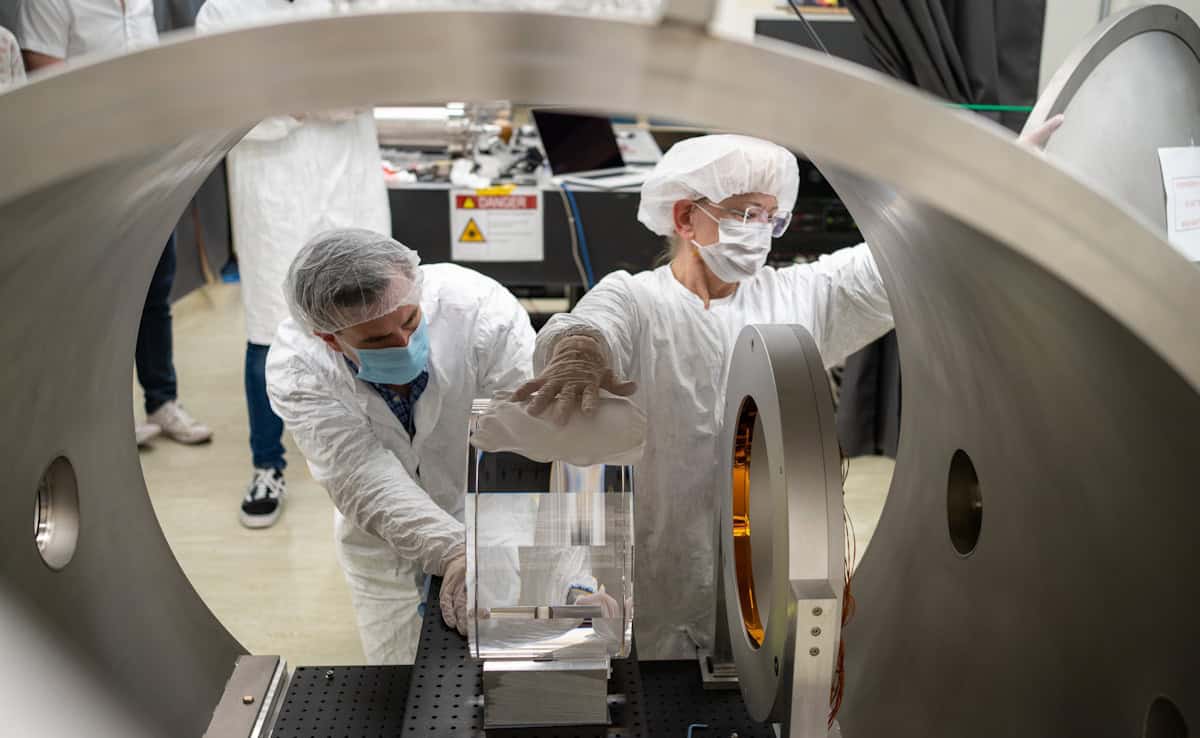
Black hole collisions, merging neutron stars, exploding supernovae – these massive cosmic events are all observed by interferometer-based gravitational-wave observatories such as LIGO. Detection of the ripples in space-time caused by these phenomena is dependent on the careful control of the mirrors used in these observatories.
Led by Jonathan Richardson at University of California, Riverside, a research team has demonstrated a new wavefront actuator that can correct deformations in the surface


Comments (0)

Sign in to join the discussion

More Like This

Hawaii battles strong winds and rain as Hurricane Lala threat looms
BBC News · 6d ago
Gorging on bearcam: the livestream of big beasts eating that draws millions
Environment | The Guardian · 6d ago
📰
People form judgments about a stranger’s trustworthiness and competence after seeing their face for just one-tenth of a second — and Princeton researchers found that more viewing time did surprisingly little to change the impression, mostly making people more confident in it.
ScienceBlog.com · 6d ago
We tend to picture the Sahara as an eternal desert, but sediment cores and cave paintings show that as recently as 6,000 years ago it was a green savanna crossed by rivers and lakes, populated by hippos, crocodiles and cattle-herding people whose rock art still survives on the walls of Tassili n’Ajjer
ScienceBlog.com · 6d ago
Quote by Viktor Frankl: Between stimulus and response there is a space, in that space is our power to choose our response, and in our response lies our growth and our freedom
ScienceBlog.com · 6d ago
📰
We assume the deepest parts of the ocean are dark and empty, but the walls of the Mariana Trench hold snailfish drifting five miles down under pressure equivalent to a car pressing on every square centimetre of skin, their bones half-dissolved into cartilage so they can bend instead of shatter
ScienceBlog.com · 6d ago